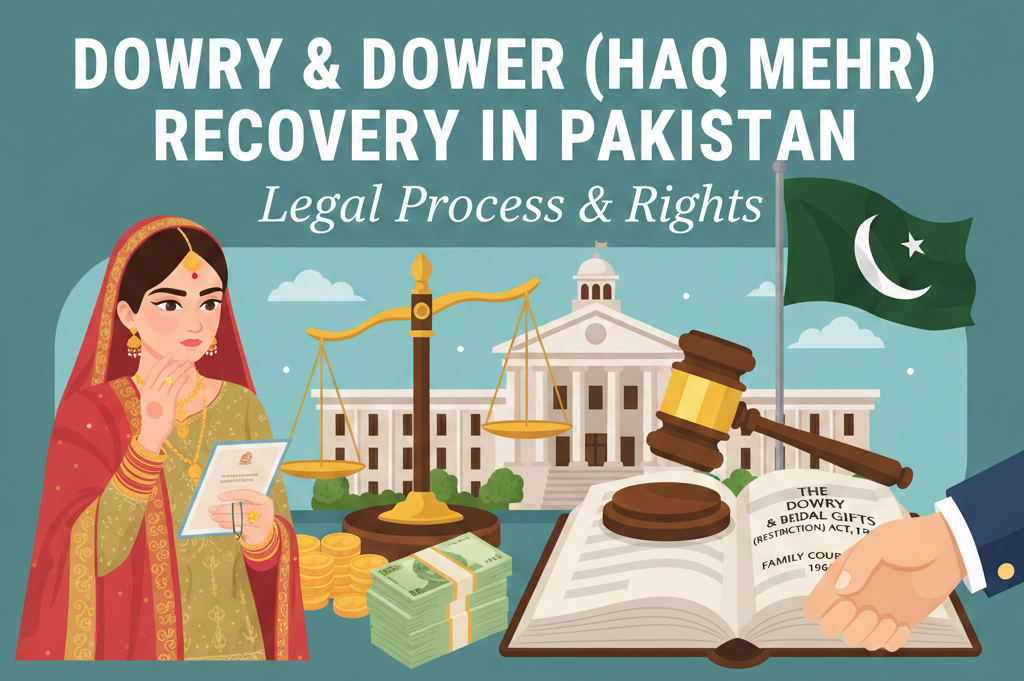
Marriage in Pakistan is a beautiful union, but sometimes things go wrong, like divorce or disputes. In such cases, many women wonder about their rights to money or gifts from marriage. Two common things people talk about are dowry and dower (Haq Mehr). Many confuse them, but they are very different.
This guide explains what each means, your legal rights, and the easy step-by-step process to recover them if needed. We use simple words so everyone can understand. This is based on Pakistan’s laws and recent court decisions (updated as of 2026).
What is Dower (Haq Mehr)?
Haq Mehr (also called dower or mahr) is a mandatory gift or payment from the husband to the wife at the time of marriage. It is the wife’s absolute right under Islamic law and Pakistani law.
- It is written in the Nikahnama (marriage contract form).
- It shows respect for the wife and acts as her financial security.
- The husband must pay it – it is both a legal and moral duty.
Types of Haq Mehr:
- Prompt (Muajjal): Payable right away or whenever the wife asks during marriage.
- Deferred (Ghair Muajjal): Payable later, usually on divorce, husband’s death, or when the wife demands it.
Recent Supreme Court rulings (like in 2024–2025 cases reported in Arab News and other sources) say: Whatever amount or items are written in the Nikahnama for Haq Mehr must be paid in full. The husband cannot avoid it. The court has made it clear that the wife can demand it at any time, even during marriage, not just after divorce.
Key Law: Muslim Family Laws Ordinance, 1961 (Section 10) says if no payment details are given, the full dower is payable on demand.
Important Point: Haq Mehr is not dowry. Dowry comes from the bride’s family; Haq Mehr comes from the husband.
What is Dowry?
Dowry (Jahez) is the opposite. It is money, clothes, furniture, jewelry, or other gifts given by the bride’s family to the groom or his family at marriage.
- In Pakistani culture, dowry is common, but it is not required by Islam.
- Many families face pressure to give big dowry, which can cause stress and problems.
- Dowry is often kept by the husband or in-laws, even after divorce.
Key Law: Dowry and Bridal Gifts (Restriction) Act, 1976 (amended in 2016).
This law:
- Limits excessive dowry and wedding expenses.
- Says dowry articles (gifts given to the bride) are the wife’s property.
- Prohibits demanding dowry as a condition of marriage.
If the husband or in-laws keep dowry items wrongly, the wife can claim them back.
Difference Between Dowry and Dower (Haq Mehr) (Simple Table):
- Haq Mehr (Dower): Husband gives to wife → Wife’s right → Mandatory in Islam → Recoverable as debt.
- Dowry: Bride’s family gives to groom/in-laws → Not Islamic requirement → Often social pressure → Wife can recover articles as her property.
Why Recovery is Important
Many women lose their Haq Mehr or dowry items after divorce or separation. But Pakistani law protects women:
- Supreme Court (2024–2025 rulings): Husbands must pay full Haq Mehr as written in Nikahnama.
- Family courts help recover both quickly.
- It gives financial help to start a new life.
Legal Process to Recover Haq Mehr (Dower)
You can recover Haq Mehr even after divorce, khula, or husband’s death. Here is the simple step-by-step process:
- Collect Documents
- Original or copy of Nikahnama (shows Haq Mehr amount).
- CNIC copies of wife and husband.
- Proof of marriage (if needed).
- Any proof of non-payment (like messages or witnesses).
- Send a Legal Notice (Recommended First Step)
- Hire a lawyer to send a formal notice to the husband demanding payment.
- Give 15–30 days to pay.
- This often solves the issue without court. Many husbands pay after notice.
- File a Suit in Family Court
- Go to the Family Court in your area (or where marriage happened or husband lives).
- File under Section 9 of the Family Courts Act, 1964 (for recovery of money/debt).
- The suit is for “recovery of dower”.
- Court fee is low (usually a few thousand rupees).
- Court Proceedings
- Court issues notice to husband.
- Both sides present evidence (Nikahnama is strong proof).
- Court usually decides fast (Family Courts are quick – months, not years).
- If wife wins, court orders husband to pay (can be cash, property, or gold as written).
- Execution if Husband Does Not Pay
- Court can attach husband’s property, salary, or bank account.
- It can be recovered like land revenue arrears.
Special Cases:
- After Khula: Wife usually gets full Haq Mehr unless she waives it. Courts protect women’s rights even if she initiates khula.
- After Husband’s Death: Widow can claim from his heirs (father-in-law, brothers-in-law).
- Prompt vs Deferred: Prompt can be demanded anytime; deferred often on divorce/death.
Legal Process to Recover Dowry Articles
Dowry recovery is similar but under different law.
- Prepare List
- Make a detailed list of dowry items (with photos, witnesses, or receipts if possible).
- Nikahnama sometimes has a dowry list section.
- Send Legal Notice
- Demand return of items.
- File Suit in Family Court
- Under Family Courts Act, 1964 and Dowry Act, 1976.
- Claim dowry as wife’s exclusive property.
- Court Order
- Court can order return of items or their value in cash.
Note: If there is harassment over dowry, file a police complaint under the Dowry Act or other laws.
Time Limit & Costs
- No strict time limit for Haq Mehr (it is a debt), but file soon to avoid issues.
- Costs: Lawyer fee (affordable), court fee low.
- Family Courts are fast and woman-friendly.
Recent Court Updates (2024–2026)
- Supreme Court (Chief Justice Yahya Afridi): Husbands bound to pay full Haq Mehr as in Nikahnama – no escape.
- Courts say wife can demand anytime.
- Strengthens women’s financial rights.
Conclusion
Haq Mehr is your Islamic and legal right – a security from your husband. Dowry items are your property too. If someone is not giving them, don’t worry. Law is on your side.
At ASR Law Associates, we help women recover Haq Mehr and dowry easily. We offer affordable, confidential help – online or in-person consultations in Faisalabad and across Pakistan.
Contact us today:
- Email: info@asrlawassociates.com
- Website: https://asrlawassociates.com/
Don’t suffer in silence. Get your rights today!
References:
- Muslim Family Laws Ordinance, 1961 (Section 10 on Dower).
- Dowry and Bridal Gifts (Restriction) Act, 1976 (as amended).
- Family Courts Act, 1964.
- Supreme Court rulings (reported in Arab News Pakistan, 2024–2025; Courting The Law, etc.).
- Legal guides from family law firms and official sources.