- 1. The Traffic Challan: Non-Criminal Regulatory Violations
- 2. How to Pay Your Traffic Challan in 2026
- 3. How to Contest a Traffic Challan
- 4. The Criminal Challan: The Section 173 CrPC Report
- 5. The Three Types of Criminal Challan Reports
- 6. Understanding the "Columns" in a Criminal Challan
- 7. What Happens After the Criminal Challan is Submitted?
- 8. Can You Challenge a Criminal Challan?
- 9. Key Differences at a Glance
- 10. Practical Tips for Handling Police Interaction
- 11. Conclusion: The Importance of Timely Action
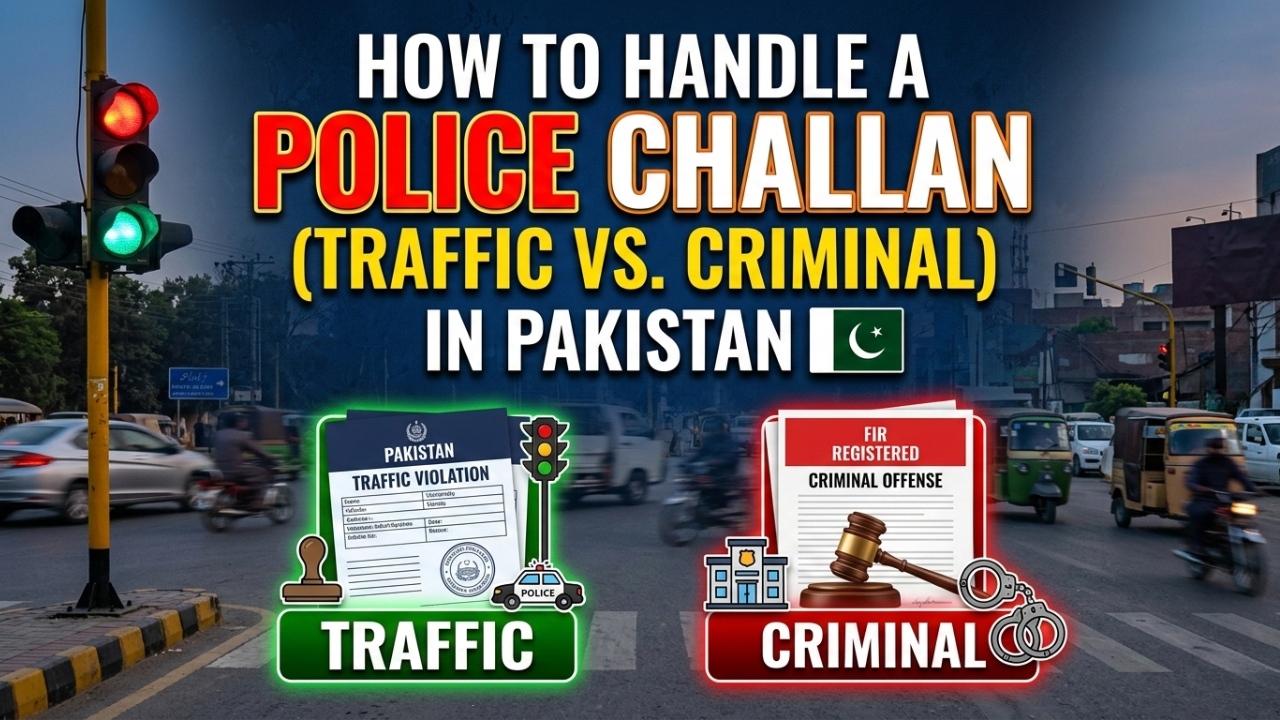
In the Pakistani legal system, the term “Challan” is a broad umbrella that covers everything from a 500 PKR speeding ticket to a high level criminal investigation report. For a citizen, receiving a challan can be a source of significant anxiety. However, the legal procedure for a Traffic Challan is fundamentally different from a Criminal Challan issued under the Code of Criminal Procedure (CrPC).
At ASR Law Associates, we believe that legal literacy is the best defense. This 1,500 word guide explains how to navigate both systems, how to pay fines through digital portals, and when you need to involve a legal professional to contest a charge.
1. The Traffic Challan: Non-Criminal Regulatory Violations
A Traffic Challan is a notice of a regulatory violation. It is governed by the Provincial Motor Vehicles Ordinance 1965 and the subsequent Motor Vehicle Rules.
Common Traffic Violations in 2026
With the implementation of the “Safe City” project in cities like Lahore, Islamabad, and Faisalabad, many challans are now generated through E-Tagging and AI cameras. Common offenses include:
- Section 112 Violations: General contravention of traffic rules.
- Speeding: Exceeding prescribed limits (Section 112-A).
- Signal Jumping: Violation of electronic or manual signals.
- Helmet/Seatbelt Violations: Mandatory safety requirements.
- Driving without a License: A serious offense that can lead to vehicle impoundment.
2. How to Pay Your Traffic Challan in 2026
In 2026, the process of paying a traffic fine has been fully digitized to eliminate the need for “middlemen” or physical visits to the bank.
Step 1: Digital Verification
If you receive an SMS or a physical ticket, you can verify it on the Punjab Police Khidmat Markaz portal or the City Traffic Police (CTP) website. Simply enter your CNIC or vehicle registration number to see the pending fine.
Step 2: Payment Methods (e-Pay Punjab)
You can pay your fine through:
- e-Pay Punjab App: Generate a PSID number and pay via mobile banking or ATM.
- Khidmat Markaz: Visit any Police Facilitation Center for manual payment.
- Bank of Punjab (BOP): The designated bank for traffic fine collection.
Step 3: Document Recovery
If the officer has confiscated your Driving License or Registration Book, you can only recover it after the system updates your payment status. Once the fine is marked as “Paid,” you can collect your documents from the designated Traffic Head Office.
3. How to Contest a Traffic Challan
Many citizens do not realize that they have the legal right to contest a traffic ticket if they believe it was issued unfairly.
- Do Not Sign the Ticket: If you intend to contest, you can refuse to sign, though the officer will still issue the ticket.
- The Traffic Court: Every district has a Special Traffic Magistrate. You must appear in court on the date mentioned on the back of the challan.
- The Hearing: You can present evidence (such as dashcam footage or witness testimony) to the Magistrate. If the court finds the evidence in your favor, the challan can be quashed.
4. The Criminal Challan: The Section 173 CrPC Report
In criminal law, a “Challan” is a very different animal. It refers to the Police Report submitted to a Magistrate upon the completion of a criminal investigation.
The Legal Framework (Section 173)
Under Section 173 of the Code of Criminal Procedure (CrPC), after an FIR is registered and the investigation is complete, the Investigating Officer (IO) must submit a report to the court. This report is commonly called the “Challan.”
What a Criminal Challan Contains:
- The Names of Parties: Accused persons and complainants.
- The Nature of Information: Summary of the alleged crime.
- The Names of Witnesses: Persons acquainted with the facts.
- The Police Opinion: Whether an offense appears to have been committed.
5. The Three Types of Criminal Challan Reports
Not every police investigation ends in a trial. The IO can submit different types of reports under Section 173:
- Complete Challan: Submitted when the investigation is finished and evidence is ready.
- Interim (Incomplete) Challan: If the investigation cannot be finished within 14 days, the police must submit an interim report. (Note: Detention beyond 14 days without an interim challan can be challenged in the High Court).
- Discharge/Cancellation Report: If the police find no evidence, they recommend the Magistrate discharge the accused and cancel the case.
6. Understanding the “Columns” in a Criminal Challan
A criminal challan is divided into specific columns that determine the fate of the accused:
- Column 1: Details of the complainant.
- Column 2: Accused persons who were found innocent by the police (but the Magistrate can still summon them if they disagree).
- Column 3: Accused persons who are in custody or on bail and are being sent for trial.
- Column 4: Accused persons who are absconding (proclaimed offenders).
7. What Happens After the Criminal Challan is Submitted?
Once the challan reaches the court, the Magistrate takes Cognizance of the offense.
Step 1: Scrutiny of Documents
The court checks if the statements of witnesses (under Section 161 CrPC) and medical reports are attached.
Step 2: Distribution of Copies
Under Section 241-A or 265-C, the court must provide free copies of the challan and witness statements to the accused at least seven days before the formal “Framing of Charge.”
Step 3: Framing of Charge (Fard-e-Jurm)
The court formally reads the charges to the accused. If the accused pleads “Not Guilty,” the trial officially begins.
8. Can You Challenge a Criminal Challan?
Yes. If you believe the police have filed a false challan against you, there are several legal remedies:
- Application under Section 249-A or 265-K: You can apply for “Acquittal” at any stage of the trial if the evidence is so weak that there is no probability of conviction.
- Quashment of FIR: You can approach the High Court under Section 561-A CrPC to quash the proceedings if they are an abuse of the law.
- Transfer of Investigation: If the IO is biased, you can apply to the District Investigation Board (DIB) or the DIG/RPO for a “Change of Investigation.”
9. Key Differences at a Glance
| Feature | Traffic Challan | Criminal Challan (Sec 173) |
| Governing Law | Motor Vehicle Ordinance 1965 | CrPC 1898 |
| Purpose | Fine for regulatory breach | Trial for a crime (PPC) |
| Result of Payment | Case closed immediately | Admission of guilt (not recommended in criminal cases) |
| Appearing in Court | Optional (only if contesting) | Mandatory for the accused |
| Impact on Character | Usually none | Can lead to a criminal record |
10. Practical Tips for Handling Police Interaction
Whether it is a traffic stop or a criminal inquiry, your behavior determines the legal outcome.
- Remain Calm and Respectful: Aggression toward a police officer is an independent offense.
- Ask for Identification: You have the right to know the name and rank of the officer.
- Do Not Give Verbal Statements: In criminal matters, anything you say to the police is generally not admissible as evidence (Article 38 of Qanoon-e-Shahadat), but it can still influence the investigation.
- Consult a Lawyer: Especially for a Criminal Challan, do not appear in court without a legal representative.
11. Conclusion: The Importance of Timely Action
A challan is not a conviction; it is an allegation. In traffic matters, paying promptly via e-Pay saves you from the hassle of court visits. In criminal matters, a Section 173 report is the foundation of your trial. If that foundation is weak or based on lies, it must be challenged at the earliest possible stage.
At ASR Law Associates, we have successfully defended clients against faulty police investigations and unfair regulatory fines. Our team ensures that your rights are protected throughout the “Challan to Trial” journey.
Need Legal Representation for a Case?
If you are facing a criminal trial or need to challenge a police report, our expert criminal defense lawyers are here to assist you.
Contact Us Today:
To schedule a confidential consultation, please visit our contact page:
Disclaimer: This guide provides general legal information and is not a substitute for professional legal advice. The procedures mentioned are based on the laws of Pakistan as of 2026.