Faisalabad, Pakistan – July 15, 2026
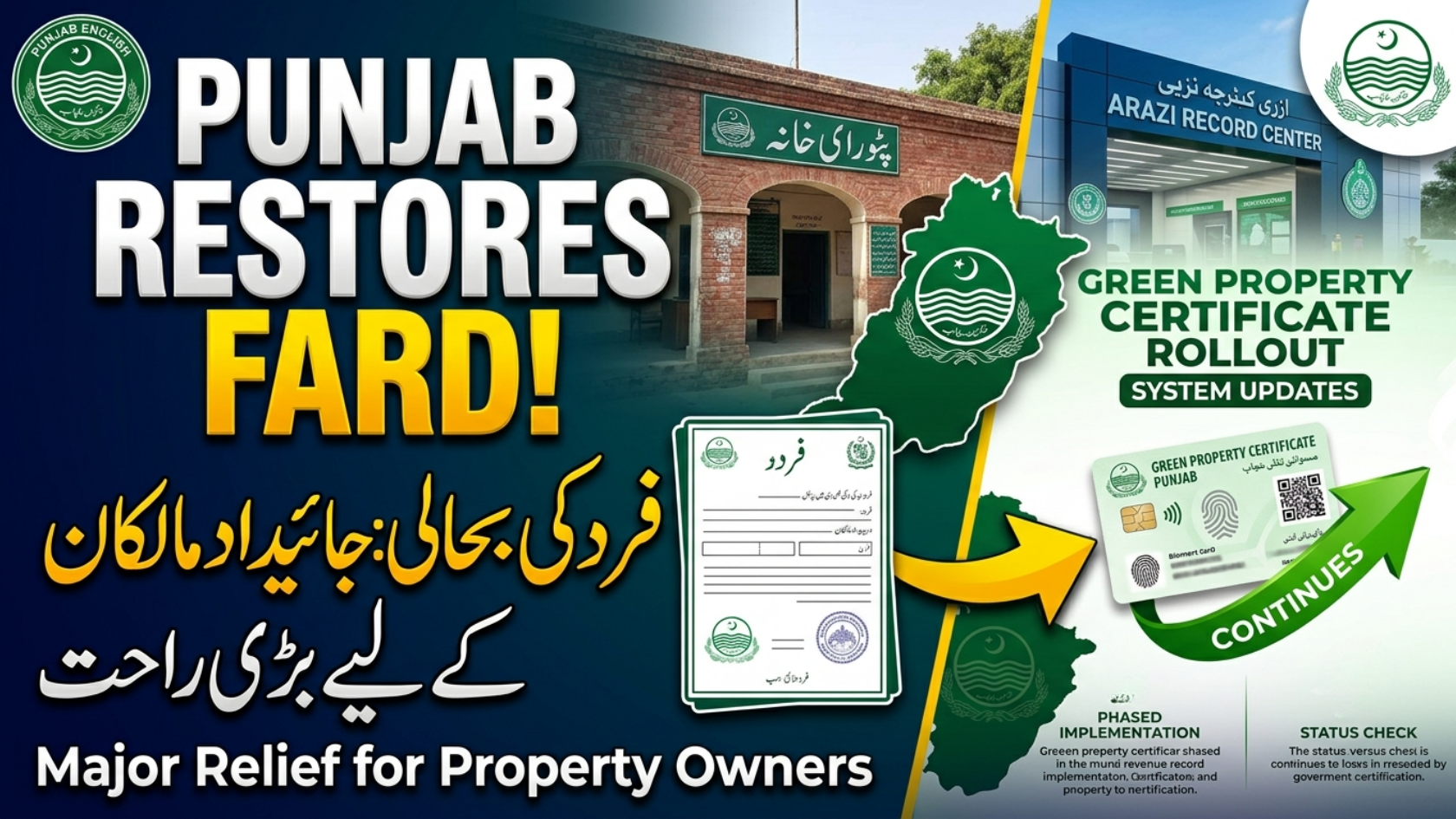
The Punjab Government has issued a major clarification regarding its new Green Property Certificate (GPC) system after days of confusion among property buyers, sellers, real estate agents, lawyers, and overseas Pakistanis. The government has officially restored the issuance of the traditional Fard (Record of Rights) in eligible non-digitized areas while continuing the phased rollout of the Green Property Certificate across Punjab. This move is expected to ease uncertainty in cities including Lahore, Faisalabad, Rawalpindi, Multan, Gujranwala, and Sialkot, where property transactions had slowed following the introduction of the new digital land verification system.
The latest notification means that buyers and sellers in areas where land records have not yet been fully digitized can once again complete property transactions using a Fard (Record of Rights) or a certified copy of the official land record, rather than being required to present a Green Property Certificate. However, the Green Property Certificate will continue to apply in areas already covered under the new digital framework.
What Is the Green Property Certificate?
The Green Property Certificate (GPC) is a digitally verified ownership certificate introduced by the Punjab Land Records Authority (PLRA) as part of the province’s ambitious land record modernization programme. The certificate is designed to improve transparency, reduce fraud, strengthen ownership verification, and simplify property transactions through secure digital records.
The certificate includes digital ownership information, QR-code verification, official authentication, and data sourced from Punjab’s computerized land records. The long-term goal is to replace outdated paper-based verification methods with a modern, tamper-resistant system that protects both buyers and sellers.
Why Was the System Introduced?
Punjab’s property sector has long struggled with forged documents, fake Fards, duplicate property sales, land disputes, illegal possession, and delays caused by manual verification procedures. These issues have affected individual homeowners, investors, overseas Pakistanis, financial institutions, and developers for years.
The Green Property Certificate initiative aims to address these long-standing problems by introducing a centralized digital verification system that enables property ownership to be confirmed more securely and efficiently. Government officials have said the reforms are intended to modernize Punjab’s land administration while reducing opportunities for fraud and manipulation.
Why Are Property Owners Confused?
Although the Green Property Certificate promises significant improvements, its implementation has created widespread confusion.
Before July 2026, property buyers generally relied on the traditional Fard when completing property transactions. When the government announced that the Green Property Certificate would replace the old verification process in many cases, many citizens believed that the traditional Fard had been permanently abolished.
As a result, buyers began demanding Green Property Certificates, sellers rushed to determine whether their existing property documents remained valid, and estate agents struggled to advise clients because implementation varied between districts.
The latest government notification has clarified that this is not a complete replacement. Instead, Punjab is currently operating under a transitional system, where both methods may be used depending on whether local land records have been digitized.
Current Status of the Green Property Certificate
As of 15 July 2026, Punjab’s property documentation system remains in a transition phase.
The Green Property Certificate continues to be implemented across digitized areas, while manual Fard services have resumed in eligible locations where digitization is still incomplete.
This means property owners should not assume that every district follows identical procedures. Instead, the applicable documentation depends on the status of the local land records maintained by the Punjab Land Records Authority.
Existing registered sale deeds (Registries) have not been cancelled simply because of the introduction of the Green Property Certificate. The recent notification primarily affects how ownership is verified for current transactions in different areas.
Impact on Lahore, Faisalabad and Other Major Cities
The uncertainty has been particularly noticeable in major urban centres.
In Lahore, property dealers reported that buyers frequently requested Green Property Certificates even where traditional documentation remained acceptable. In Faisalabad, many sellers expressed concerns that they would be unable to transfer property without converting older records into the new format. Similar uncertainty has also been reported in Rawalpindi, Gujranwala and Multan as officials continue implementing the new digital framework in phases.
The government’s latest clarification is expected to reduce delays in property transfers while allowing digitization to continue without disrupting transactions in areas that are not yet fully computerized.
Benefits of the Green Property Certificate
Once fully implemented across Punjab, the Green Property Certificate is expected to deliver several benefits, including:
- Improved property ownership verification.
- Reduced risk of forged documents.
- Faster property due diligence.
- Greater transparency in land records.
- Stronger protection against fraudulent transactions.
- Simplified digital verification through QR-code technology.
- Increased confidence for investors and overseas Pakistanis.
Officials believe these reforms will help modernize Punjab’s real estate sector while making property transactions safer and more efficient.
Challenges That Still Remain
Despite its advantages, the rollout continues to face practical challenges.
The biggest issue is that Punjab’s land records have not yet been digitized uniformly across every district. This has resulted in different procedures being followed in different locations.
Many property owners also remain unfamiliar with the Green Property Certificate, while social media rumours have incorrectly suggested that all existing Registries and Fards have become invalid. The government’s recent notification indicates that this is not the case and confirms that manual Fard services continue in eligible non-digitized areas.
What Property Buyers and Sellers Should Do
Anyone planning to buy or sell property in Punjab should first confirm the documentation requirements applicable to the specific property’s location. Buyers should verify ownership through the Punjab Land Records Authority and ensure that all ownership records are current before completing a transaction.
Because implementation continues to evolve, checking the latest guidance from the relevant Arazi Record Center or PLRA office can help avoid unnecessary delays.
Outlook
The Green Property Certificate remains one of the most significant land administration reforms undertaken by the Punjab Government in recent years. While the transition has caused temporary confusion, officials continue expanding the digital system with the stated objective of creating a transparent, secure and fraud-resistant property ownership framework for the province.
For now, both the traditional Fard and the Green Property Certificate will continue to operate according to the digitization status of each area, allowing property transactions to proceed while Punjab completes its broader land record modernization programme.
Also Read
What Green Property Certificate Punjab: How to Apply, Fees, and Benefits
Official Resources & References
- Punjab Land Records Authority (PLRA) – Official Website: https://www.punjab-zameen.gov.pk/
- Green Property Certificate Information (Official PLRA): https://www.punjab-zameen.gov.pk/greenCertificateInfo
- Punjab Board of Revenue (BoR): https://bor.punjab.gov.pk/
- ProPakistani – Punjab Restores Manual Land Record Certificates (11 July 2026): Read Article
- Bloom Pakistan – Punjab Restores Issuance of Manual Land Record Certificates: Read Article
- Green Property Certificate Punjab 2026 – Complete Guide: Lahore Real Estate Guide
- Punjab Land Records Revolution 2026 – Green Property Certificate, Fard & Naqal Arazi Record: Read Guide
- How to Apply for a Green Property Certificate (Video Guide): Watch on YouTube