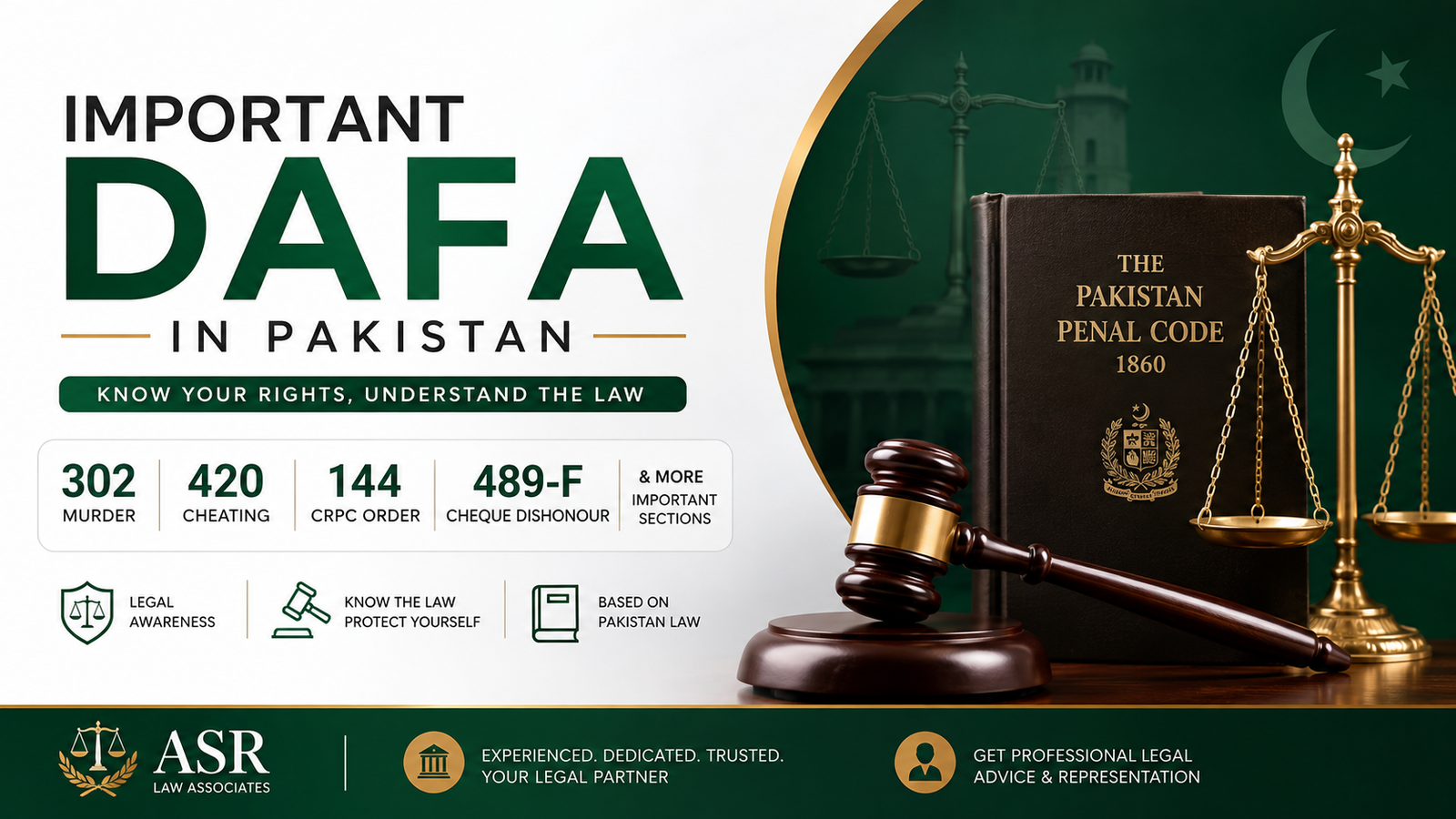
If you have ever heard someone say “Dafa 302 lag gayi,” “Dafa 420 ka case hai,” “Dafa 144 lagi hui hai,” or “489-F ka case hai,” you may have wondered what these numbers actually mean.
In Pakistan, Dafa (دفعہ) is commonly used to refer to a section or provision of a law. These sections can define criminal offences, prescribe punishments, establish legal procedures or give authorities specific powers.
Some of the most commonly searched legal sections in Pakistan include Dafa 302, Dafa 324, Dafa 337, Dafa 354, Dafa 376, Dafa 406, Dafa 420, Dafa 489-F, Dafa 506 and Dafa 144.
Understanding these sections can help you make sense of an FIR, police case, court proceeding, legal notice or news report.
However, one important distinction should be understood from the beginning: Dafa 144 is part of the Code of Criminal Procedure, 1898 (CrPC), while sections such as 302 and 420 are provisions of the Pakistan Penal Code, 1860 (PPC). The Pakistan Code is the federal government’s official online resource for accessing Pakistani legislation.
What Does Dafa Mean in Pakistani Law?
The word Dafa is commonly used in Pakistan to describe a section of a law.
For example:
- Dafa 302 PPC relates to punishment for qatl-i-amd.
- Dafa 324 PPC concerns attempt to commit qatl-i-amd.
- Dafa 420 PPC concerns cheating and dishonestly inducing delivery of property.
- Dafa 489-F PPC concerns dishonestly issuing a cheque in circumstances covered by the law.
- Dafa 506 PPC concerns punishment for criminal intimidation.
- Dafa 144 CrPC concerns certain urgent orders relating to nuisance or apprehended danger.
The number alone is not enough. To understand a Dafa properly, you should also identify the law, the exact wording of the section, any relevant subsection and the facts of the case.
Dafa 302 in Pakistan
What Is Dafa 302?
Dafa 302 PPC is one of the most well-known criminal provisions in Pakistan.
It provides punishment for qatl-i-amd, subject to the applicable provisions and circumstances under the Pakistan Penal Code.
Because qatl-i-amd involves intentional killing within the legal definition, Section 302 is associated with some of the most serious criminal cases in Pakistan.
Dafa 302 in simple words
If someone is accused of intentionally causing another person’s death in circumstances falling within the legal definition of qatl-i-amd, Dafa 302 may be included in the case.
Is Dafa 302 the same as murder?
In everyday conversation, people commonly call a Section 302 case a murder case. Legally, however, the exact offence and applicable provision should be determined from the wording of the PPC and the facts of the case.
Does Dafa 302 automatically mean conviction?
No.
An FIR is an allegation. A person charged under Section 302 is not automatically guilty. The prosecution must establish its case through the applicable legal process.
Dafa 324 in Pakistan
What Is Dafa 324?
Dafa 324 PPC is commonly known as the provision concerning attempt to commit qatl-i-amd and is often described as an attempted murder provision.
It may become relevant where an accused allegedly performs an act with the relevant intention or knowledge but the victim does not die.
Example
If a person allegedly shoots at another person and the victim survives, Section 324 may be considered depending on the circumstances and evidence.
The exact legal position can depend on:
- The intention of the accused
- The nature of the act
- Weapon allegedly used
- Injuries suffered
- Medical evidence
- Witness statements
- Other applicable sections
Dafa 337 in Pakistan
What Is Dafa 337?
The Dafa 337 series of the Pakistan Penal Code covers different forms and categories of hurt and injuries.
This means that saying “337 ka case hai” does not necessarily provide enough information to understand the allegation.
The specific subsection can be important.
Why is Dafa 337 important?
In an injury case, matters such as the nature and severity of the injury, medical evidence and circumstances of the incident can affect which legal provision applies.
A medico-legal examination may therefore become important in cases involving allegations of physical injury.
Dafa 354 in Pakistan
What Is Dafa 354?
Dafa 354 PPC concerns assault or criminal force against a woman in circumstances covered by the section, including the relevant intention or knowledge concerning the outraging of her modesty.
The provision can become relevant in certain cases involving alleged inappropriate physical conduct against a woman.
The exact facts of the incident are important in determining whether the legal requirements of the section are satisfied.
Dafa 376 in Pakistan
What Is Dafa 376?
Dafa 376 PPC deals with punishment for rape.
It is one of the serious criminal provisions concerning sexual offences in Pakistan.
The applicable punishment and legal provisions can depend on the specific circumstances and applicable subsections.
Cases involving sexual offences can involve complex questions relating to:
- Consent
- Age
- Medical evidence
- Forensic evidence
- Witness testimony
- Circumstances of the alleged offence
- Other applicable laws
Anyone involved in such a case should obtain advice from a qualified lawyer rather than relying on general information online.
Dafa 406 in Pakistan
What Is Dafa 406?
Dafa 406 PPC concerns criminal breach of trust.
Broadly, criminal breach of trust can arise where property or control over property has been entrusted to a person and that person is alleged to dishonestly misappropriate, convert or use it in a manner covered by the law.
Example
If a person receives money or property for a specific purpose and allegedly dishonestly converts it for their own use, Section 406 may become relevant depending on the facts.
Is every unpaid amount a Dafa 406 case?
No.
A business dispute, unpaid loan, contractual disagreement or failure to make a payment does not automatically establish criminal breach of trust.
The specific legal ingredients must be considered.
Dafa 420 in Pakistan
What Is Dafa 420?
Dafa 420 PPC is one of the most commonly searched legal sections in Pakistan.
It concerns cheating and dishonestly inducing delivery of property.
People commonly search for:
- Dafa 420 kya hai?
- Dafa 420 ki saza kya hai?
- Dafa 420 bail
- Dafa 420 FIR
- Dafa 420 case in Pakistan
- Dafa 420 PPC
Dafa 420 in simple words
Section 420 may apply when a person is alleged to have committed cheating and dishonestly induced another person to deliver property or to make, alter or destroy a valuable security, where the legal requirements are satisfied.
Example
A person allegedly makes a dishonest representation to another person in order to obtain money or property.
Depending on the facts and evidence, Dafa 420 may become relevant.
Is every fraud case Dafa 420?
Not necessarily.
The exact definition of cheating and the required dishonest intention matter. A simple business disagreement or unpaid debt does not automatically become a Section 420 offence.
Dafa 489-F in Pakistan
What Is Dafa 489-F?
Dafa 489-F PPC is particularly important in Pakistan because it is frequently associated with cheque cases and financial disputes.
The provision concerns dishonestly issuing a cheque toward repayment of a loan or fulfilment of an obligation where the cheque is dishonoured on presentation, subject to the requirements and defence contained in the law.
Is every bounced cheque a 489-F case?
No.
This is one of the most important points to understand.
The dishonouring of a cheque alone does not necessarily answer every legal question under Section 489-F. The circumstances surrounding the cheque, the underlying obligation and the required dishonest intention can be relevant.
Common searches related to Dafa 489-F
- 489-F kya hai?
- Dafa 489-F ki saza
- 489-F bail
- 489-F FIR
- 489-F cheque case
- cheque bounce case Pakistan
- cheque dishonour law Pakistan
The Code of Criminal Procedure also identifies Section 489-F among offences under the PPC in its relevant procedural schedules.
Dafa 506 in Pakistan
What Is Dafa 506?
Dafa 506 PPC provides punishment for criminal intimidation.
The PPC provides a general punishment of imprisonment that may extend to two years, or fine, or both, while specified serious threats can attract more severe punishment under the section.
What is criminal intimidation?
The related definition in Section 503 concerns threatening another person with injury to their:
- Person
- Reputation
- Property
or to the person or reputation of someone in whom they are interested, with the legally required intention.
Example
If someone allegedly threatens another person with serious harm in order to frighten them or force them to do something they are not legally required to do, criminal intimidation provisions may become relevant.
The precise words, circumstances and intention are important.
Dafa 34 in Pakistan
What Is Dafa 34?
Dafa 34 PPC concerns acts done by several persons in furtherance of their common intention.
This section is frequently seen alongside another substantive criminal offence in cases involving multiple accused persons.
Example
If several people are alleged to have acted together with a common intention in committing an offence, Section 34 may become relevant depending on the evidence.
However, simply being present at the scene of an incident does not automatically establish liability under Section 34.
The legal requirements must be proved.
Dafa 149 in Pakistan
What Is Dafa 149?
Dafa 149 PPC concerns liability of members of an unlawful assembly for offences committed in prosecution of the common object of that assembly, subject to the requirements of the law.
It is commonly seen in cases involving multiple accused persons.
Dafa 149 may appear alongside allegations involving:
- Rioting
- Assault
- Violence
- Property damage
- Weapons
- Other criminal offences
The exact facts and evidence determine whether the provision applies.
Dafa 147 in Pakistan
What Is Dafa 147?
Dafa 147 PPC concerns rioting.
It can become relevant where members of an unlawful assembly use force or violence in circumstances covered by the Pakistan Penal Code.
Other sections may be included depending on the alleged conduct.
Dafa 148 in Pakistan
What Is Dafa 148?
Dafa 148 PPC concerns rioting while armed with a deadly weapon or something which, when used as a weapon, is likely to cause death.
It may therefore be relevant where an allegation involves both rioting and possession or use of a dangerous weapon.
Dafa 379 in Pakistan
What Is Dafa 379?
Dafa 379 PPC provides punishment for theft.
The PPC defines theft in relation to dishonest taking of movable property out of another person’s possession without consent.
Common examples can include allegations involving stolen:
- Mobile phones
- Cash
- Jewellery
- Electronics
- Other movable property
The specific facts must satisfy the legal definition of theft.
Dafa 392 in Pakistan
What Is Dafa 392?
Dafa 392 PPC concerns punishment for robbery.
Robbery is legally different from ordinary theft because the law identifies additional circumstances involving violence, threat of immediate violence or related conduct.
Theft vs robbery
Theft: Dishonestly taking property.
Robbery: Theft or extortion accompanied by circumstances specified by law, including relevant violence or threats of immediate violence.
Dafa 395 in Pakistan
What Is Dafa 395?
Dafa 395 PPC concerns dacoity.
The concept of dacoity under the PPC involves robbery or attempted robbery by five or more persons.
This is why the term is commonly associated with cases involving group robberies.
Dafa 452 in Pakistan
What Is Dafa 452?
Dafa 452 PPC concerns house-trespass or house-breaking after preparation for causing hurt, assault or wrongful restraint, or creating fear of these things.
It can therefore become relevant in serious incidents involving alleged unlawful entry into a house together with preparation for violence or restraint.
Dafa 511 in Pakistan
What Is Dafa 511?
Dafa 511 PPC deals with certain attempts to commit offences where the Pakistan Penal Code does not provide a separate punishment for the attempt.
The law distinguishes between merely thinking about committing an offence and actually taking steps toward committing it.
Therefore, whether Section 511 applies depends on the conduct, intention and offence involved.
Dafa 144 in Pakistan
What Is Dafa 144?
One of the most commonly searched questions in Pakistan is:
“Dafa 144 kya hai?”
There is an important distinction here.
Dafa 144 is a provision of the Code of Criminal Procedure, 1898 (CrPC), not the Pakistan Penal Code.
Section 144 concerns certain urgent written orders relating to nuisance or apprehended danger. It can be used in circumstances where immediate prevention or speedy remedy is considered necessary to prevent specified risks, including danger to human life, health or safety or disturbance of public tranquillity.
Why is Dafa 144 imposed?
Depending on the circumstances, an order may address matters involving:
- Public safety
- Public order
- Potential violence
- Riots or apprehended disturbances
- Other risks covered by the law
Does Dafa 144 mean everything is banned?
No.
The restrictions depend on the actual order or notification issued by the competent authority.
This means that when Dafa 144 is imposed in a particular city or district, people should check the specific notification to understand what activities are restricted and for how long.
PPC and CrPC: What Is the Difference?
This distinction is essential when discussing Dafa in Pakistan.
Pakistan Penal Code, 1860
The Pakistan Penal Code (PPC) primarily defines criminal offences and their punishments.
Commonly discussed examples include:
- Dafa 302
- Dafa 324
- Dafa 354
- Dafa 376
- Dafa 379
- Dafa 406
- Dafa 420
- Dafa 489-F
- Dafa 506
Code of Criminal Procedure, 1898
The CrPC primarily deals with criminal procedure.
It covers matters relating to the operation of criminal justice, including investigation, proceedings and various procedural powers.
Dafa 144 is an example of a CrPC provision.
The official Pakistan Code currently lists both the Pakistan Penal Code and Code of Criminal Procedure among federal laws and notes that they are under review. The site also advises users to refer to original Gazette notifications where necessary.
What Is an FIR in Pakistan?
FIR stands for First Information Report.
It is the formal recording by police of information relating to a cognizable criminal offence.
An FIR can contain one or multiple Dafas depending on the allegations.
For example, an FIR may include allegations relating to:
- Murder
- Attempted murder
- Hurt
- Threats
- Theft
- Robbery
- Cheating
- Criminal breach of trust
- Unlawful assembly
Does an FIR prove guilt?
No.
An FIR records allegations and forms part of the criminal process. It is not itself a conviction.
The accused remains entitled to the protections and procedures provided by law, and guilt must be determined through the appropriate legal process.
Can More Than One Dafa Be Included in an FIR?
Yes.
A single incident may involve allegations relating to multiple offences.
For example, an alleged violent incident involving several people could potentially raise issues concerning:
- Hurt
- Criminal intimidation
- Common intention
- Unlawful assembly
- Weapons
The actual sections depend on the facts and applicable law.
What Does Bailable and Non-Bailable Mean?
When people see an FIR, one of their first questions is often:
“Is this Dafa bailable?”
Bailable offence
In a bailable offence, the law provides a framework under which bail is generally available as a right, subject to the applicable legal requirements.
Non-bailable offence
A non-bailable offence does not mean that bail is impossible.
It means that bail is not automatically available as a right in the same manner as a bailable offence. The court considers the applicable law and circumstances.
Therefore:
Non-bailable does not mean “no bail.”
Does a Dafa in an FIR Mean the Person Is Guilty?
No.
This is one of the most important points for anyone dealing with Pakistani criminal law.
An FIR contains allegations.
A criminal charge is not the same as a conviction.
A case can develop during investigation and court proceedings, and the final outcome depends on the applicable law and evidence.
Therefore, statements such as:
“302 lag gayi, is liye woh guilty hai”
are legally incorrect.
A person accused of an offence is not automatically convicted merely because a particular Dafa appears in an FIR.
Can Dafas Be Added or Changed?
The legal sections applicable to a case can change as investigation and proceedings develop, depending on the facts, evidence and applicable procedure.
An initial FIR should therefore not necessarily be treated as the final determination of every legal issue.
If you or someone in your family has been named in an FIR, have the actual FIR and related documents reviewed by a lawyer rather than relying only on the section numbers mentioned verbally.
Important Dafa in Pakistan: Quick Reference Table
| Dafa | Common Meaning |
|---|---|
| 34 PPC | Common intention |
| 109 PPC | Abetment |
| 144 CrPC | Urgent orders concerning nuisance or apprehended danger |
| 147 PPC | Rioting |
| 148 PPC | Rioting while armed with a deadly weapon |
| 149 PPC | Liability of members of unlawful assembly |
| 302 PPC | Punishment for qatl-i-amd |
| 324 PPC | Attempt to commit qatl-i-amd |
| 337 PPC series | Different forms of hurt |
| 354 PPC | Assault or criminal force against a woman |
| 376 PPC | Rape |
| 379 PPC | Theft |
| 392 PPC | Robbery |
| 395 PPC | Dacoity |
| 406 PPC | Criminal breach of trust |
| 420 PPC | Cheating and dishonestly inducing delivery of property |
| 452 PPC | House-trespass/house-breaking with specified preparation |
| 489-F PPC | Dishonestly issuing certain cheques |
| 506 PPC | Criminal intimidation |
| 511 PPC | Certain attempts to commit offences |
Frequently Asked Questions About Dafa in Pakistan
What is Dafa 302 in Pakistan?
Dafa 302 PPC provides punishment for qatl-i-amd under the circumstances specified by the Pakistan Penal Code.
What is Dafa 420 in Pakistan?
Dafa 420 PPC concerns cheating and dishonestly inducing delivery of property.
What is Dafa 144 in Pakistan?
Dafa 144 is a provision of the Code of Criminal Procedure, 1898 concerning certain urgent orders relating to nuisance or apprehended danger. It is not a provision of the Pakistan Penal Code.
What is Dafa 489-F in Pakistan?
Dafa 489-F PPC concerns dishonestly issuing a cheque toward repayment of a loan or fulfilment of an obligation in circumstances covered by the law when the cheque is dishonoured on presentation.
What is Dafa 324 in Pakistan?
Dafa 324 PPC concerns attempt to commit qatl-i-amd and is commonly referred to as an attempted murder provision.
What is Dafa 376 in Pakistan?
Dafa 376 PPC deals with punishment for rape.
What is Dafa 506 in Pakistan?
Dafa 506 PPC concerns punishment for criminal intimidation. The punishment can depend on the nature of the threat and circumstances specified by the provision.
Is Dafa 420 a fraud case?
Dafa 420 concerns the specific offence of cheating and dishonestly inducing delivery of property. Although commonly described as a fraud provision, the legal ingredients of the offence must be established.
Is every bounced cheque a 489-F case?
No. The circumstances surrounding the cheque, underlying obligation, dishonesty and other legal requirements matter.
Does an FIR mean someone is guilty?
No. An FIR contains allegations and forms part of the criminal process. It is not a conviction.
Can one FIR have several Dafas?
Yes. Depending on the allegations and facts, multiple sections can be included in one FIR.
Does non-bailable mean there is no bail?
No. Non-bailable does not mean bail is legally impossible. The applicable law and circumstances determine whether bail may be granted.
When Should You Consult a Criminal Lawyer?
You should consider obtaining professional legal advice if you or a family member:
- Has been named in an FIR
- Has received a criminal complaint
- Is facing possible arrest
- Needs bail
- Has been accused under Dafa 302
- Has been accused under Dafa 324
- Is facing a Dafa 420 case
- Is involved in a Dafa 489-F cheque case
- Has received threats of an FIR
- Has been called by police regarding a criminal allegation
- Is involved in a criminal trial
- Needs to challenge or respond to criminal proceedings
A lawyer can examine the actual documents and determine what legal options may be available.
Understanding Dafa in Pakistan
Knowing the basic meaning of common Dafa in Pakistan can make legal documents, FIRs and court proceedings much easier to understand.
Among the most commonly discussed provisions are Dafa 302, 324, 337, 354, 376, 379, 392, 395, 406, 420, 489-F, 506 and 144.
But a Dafa number is only the beginning.
The exact wording of the law, applicable subsection, facts of the incident, evidence, amendments and court interpretation can all affect how a case is handled.
If you are facing an FIR, arrest, bail matter, criminal complaint or court case, do not rely solely on an internet search for legal advice. Have your case and documents reviewed by a qualified Pakistani lawyer.
Legal Disclaimer: This article is intended for general information and educational purposes only. The application of a legal section depends on the facts, evidence, applicable legislation, amendments and judicial interpretation. Being named in an FIR or charged under a Dafa does not mean that a person has been convicted. For advice concerning a specific case, FIR, arrest, bail or legal dispute, consult a qualified lawyer.
Need Legal Assistance?
ASR Law Associates provides legal assistance for clients dealing with criminal matters, FIRs, bail, litigation and other legal issues in Pakistan.
For a case-specific assessment, contact ASR Law Associates and provide the relevant details and documents for professional legal advice.