
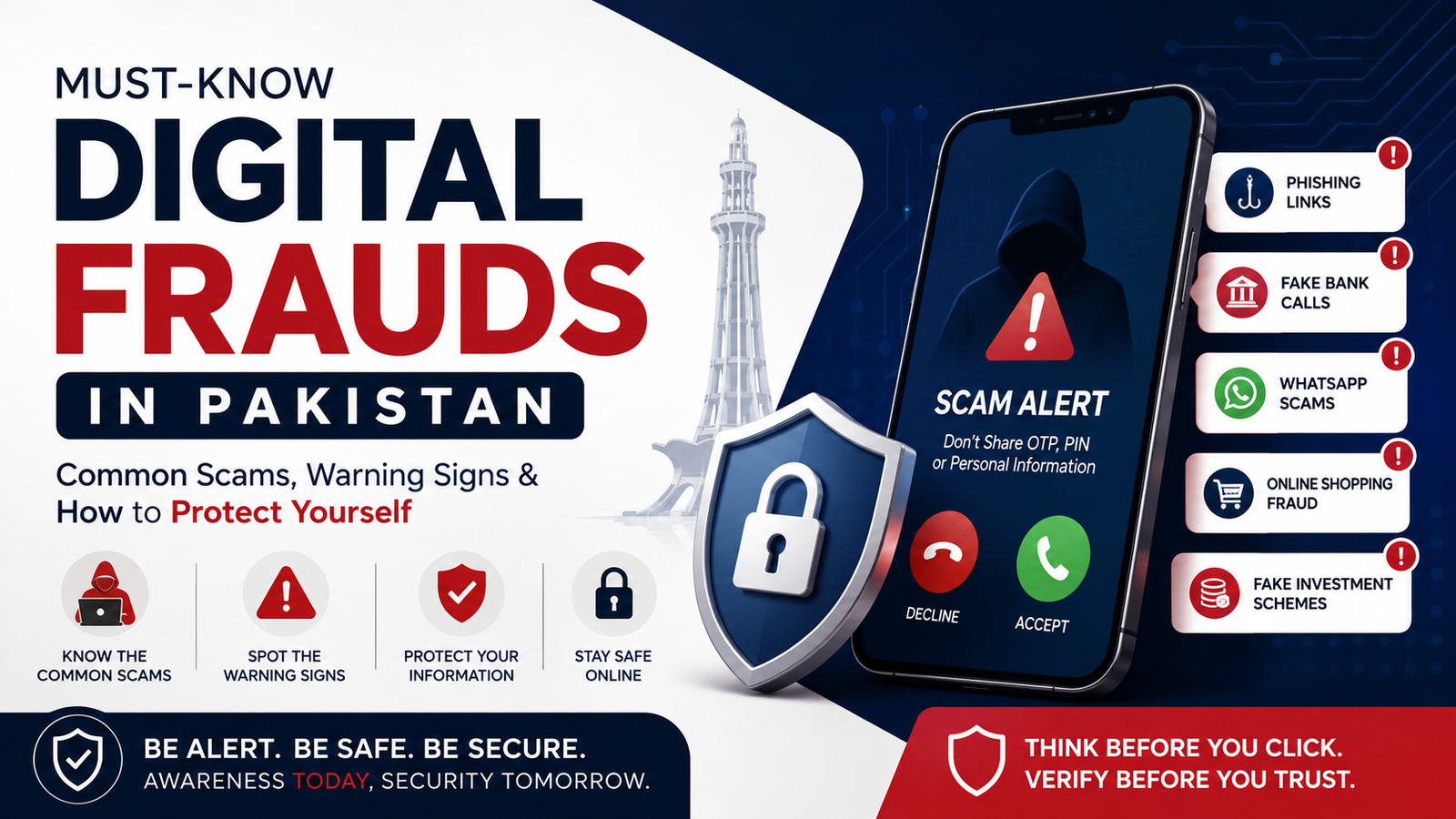
Digital technology has made banking, shopping, communication and business easier than ever. But as more Pakistanis use mobile banking, digital wallets, social media and online marketplaces, digital fraud in Pakistan has also become an increasingly important concern.
A scammer may pretend to be a bank representative, government official, courier company, employer, online seller, friend or even a family member. Sometimes, all it takes is one phone call, WhatsApp message, fake website or suspicious link for someone to lose money or personal information.
The good news is that many online scams in Pakistan follow recognizable patterns.
Knowing the most common types of digital fraud, understanding their warning signs and knowing what to do after becoming a victim can significantly reduce the risk.
This guide explains the most common digital frauds in Pakistan, including phishing scams, fake bank calls, OTP fraud, WhatsApp scams, online shopping fraud, fake investment schemes, identity theft, social media impersonation and other common cyber scams.
What Is Digital Fraud?
Digital fraud is fraudulent activity carried out using computers, smartphones, websites, social media, messaging applications, electronic payment systems or other digital technologies.
The objective is usually to:
- Steal money
- Obtain banking information
- Steal passwords
- Obtain OTPs
- Access social media accounts
- Steal identity information
- Gain unauthorized access to accounts
- Trick victims into transferring money
- Collect sensitive personal information
- Impersonate another person or organization
In Pakistan, cybercrime is governed in part by the Prevention of Electronic Crimes Act, 2016 (PECA), which was amended in 2025. The amended law provides for the National Cyber Crime Investigation Agency (NCCIA) as the investigation agency for offences specified under the Act.
Why Are Digital Frauds Increasing in Pakistan?
Pakistan has experienced rapid growth in:
- Mobile banking
- Internet banking
- Digital wallets
- Online shopping
- Social media
- WhatsApp communication
- Freelancing
- E-commerce
- Online investment platforms
- Digital payments
These services provide convenience, but scammers also use the same technology to target unsuspecting people.
The State Bank of Pakistan (SBP) has issued measures concerning digital banking security, including controls relating to digital payment fraud and customer authentication.
The important lesson is simple:
Technology is not the problem. Trusting the wrong person or link is often the problem.
1. Fake Bank Calls and Bank Representative Scams
One of the most common forms of online banking fraud in Pakistan involves scammers pretending to be representatives of a bank.
You may receive a call from someone claiming:
“Your account has been blocked.”
or:
“There is a suspicious transaction on your account.”
The caller may then ask for:
- OTP
- PIN
- Password
- CNIC information
- Card details
- Account information
- Login credentials
The scammer may create a sense of urgency so that you do not have time to think.
Warning signs
Be suspicious if someone:
- Calls unexpectedly claiming to be from your bank
- Creates panic about your account
- Demands an OTP
- Requests your PIN
- Asks for your online banking password
- Tells you to transfer money to another account for “security”
- Sends you a link to “verify” your account
What should you do?
End the call and contact your bank through the official number or application, not the number provided by the caller.
NCCIA specifically warns people not to share PINs, passwords or OTPs with anyone, even someone claiming to represent a bank.
2. OTP Fraud in Pakistan
OTP fraud is another major digital scam.
OTP means One-Time Password. It is often used as an additional authentication method for online transactions or account access.
A scammer may call you and say:
“You will receive an OTP. Please tell me the code so I can cancel the transaction.”
The real purpose may be to authorize a transaction or gain access to your account.
Never share your OTP
Your OTP is intended for your authentication.
A legitimate bank representative should not need you to disclose your OTP over a phone call.
If someone asks for your OTP, treat it as a major warning sign.
3. Phishing Scams in Pakistan
Phishing is one of the most common forms of online fraud worldwide and is increasingly relevant to Pakistani internet users.
A phishing scam typically uses a fake message, website or email designed to look legitimate.
For example, you might receive:
“Your bank account requires verification.”
or:
“Your parcel could not be delivered. Click here.”
The link may take you to a fake website designed to steal your login details or payment information.
NCCIA specifically warns about phishing messages and suspicious links requesting personal or financial information.
Common phishing targets
Scammers may impersonate:
- Banks
- Courier companies
- Government departments
- Online stores
- Social media platforms
- Mobile operators
- Payment services
- Employers
Warning signs of phishing
Look carefully for:
- Strange website addresses
- Misspelled domain names
- Unexpected messages
- Urgent requests
- Threatening language
- Requests for passwords
- Requests for card details
- Suspicious attachments
- Offers that seem too good to be true
4. Fake Courier and Parcel Delivery Scams
Online shopping has created another opportunity for scammers.
A person may receive an SMS or WhatsApp message claiming:
“Your parcel is waiting. Pay Rs. 150 to complete delivery.”
The message may contain a malicious or fraudulent link.
The victim clicks the link and may be directed to a fake payment page.
How to stay safe
If you are expecting a parcel:
- Check the order through the original shopping platform.
- Open the courier’s official website manually.
- Use the tracking number provided with your actual order.
- Do not enter banking information into an unfamiliar website.
- Do not click unexpected payment links.
NCCIA has specifically identified unsolicited messages asking recipients to click links for parcel delivery as a type of online financial fraud.
5. WhatsApp Scams in Pakistan
WhatsApp has become one of the most widely used communication platforms in Pakistan, which also makes it attractive to scammers.
Common WhatsApp scams include:
- Fake job offers
- Fake investment opportunities
- Fake loan offers
- Fake prize messages
- Account takeover attempts
- Impersonation scams
- Fake family emergencies
- Fake business opportunities
A scammer may also create a WhatsApp account using someone’s photograph and pretend to be that person.
Example
You receive a message:
“I’m using a new number. I urgently need Rs. 50,000. Please send it to this account.”
Before transferring anything, call the person using their previously known number.
Do not rely solely on a WhatsApp profile picture or name.
6. WhatsApp Account Takeover
Another serious threat is WhatsApp account takeover.
A scammer may attempt to convince you to share a verification code sent to your phone.
Once the attacker obtains the necessary information, they may attempt to gain control of your WhatsApp account and contact your friends and family while pretending to be you.
Protect your WhatsApp account
- Never share verification codes.
- Enable two-step verification.
- Review linked devices regularly.
- Avoid clicking suspicious links.
- Do not give strangers access to your phone.
- Be cautious if someone asks you for a code “by mistake.”
7. Fake Online Shopping Websites
Not every online store is genuine.
A fraudulent website may:
- Offer extremely low prices
- Copy the design of a legitimate store
- Use stolen product photographs
- Offer unrealistic discounts
- Demand advance payment
- Have no verifiable business information
- Disappear after receiving payments
Warning signs of a fake online store
Be careful when you see:
90% OFF + Limited Time + Pay Now
especially when the website has no credible business identity.
Before purchasing, check:
- Website domain
- Contact information
- Return policy
- Reviews
- Social media presence
- Business address
- Payment methods
- Customer complaints
8. Investment and Trading Scams
Investment fraud is another major category of digital scams in Pakistan.
Scammers may promise:
- Guaranteed profits
- Daily returns
- Cryptocurrency profits
- Forex income
- Stock market returns
- “AI trading”
- Passive income
- Double your money
- Exclusive investment opportunities
A common tactic is to show fake profits inside an application or website.
Initially, the victim may even be allowed to withdraw a small amount.
After gaining trust, the scammer asks for a much larger investment.
Then suddenly:
The account is frozen.
The scammer may demand another payment for:
- Tax
- Verification
- Withdrawal fee
- Processing fee
- Security deposit
This is a major warning sign.
Remember
No legitimate investment can guarantee unlimited or risk-free profits.
Be especially careful with investment opportunities promoted through WhatsApp, Telegram, Facebook, Instagram and unsolicited messages.
NCCIA warns against offers promising quick money and fake investment schemes.
9. Fake Job and Work-from-Home Scams
Pakistan has a large online freelancing and employment community, making fake job advertisements another common scam.
A fraudulent “employer” may promise:
- Remote work
- High salary
- Easy data entry
- International employment
- Online typing jobs
- Freelancing income
- Government jobs
- Overseas employment
Then the victim is asked to pay:
- Registration fee
- Security fee
- Training fee
- Visa processing fee
- Equipment fee
- Application fee
Warning sign
If someone asks you to pay money before giving you a job, investigate carefully.
A professional employer should be verifiable.
Check the company’s:
- Official website
- LinkedIn presence
- Business registration
- Email domain
- Physical address
- Employees
- Reputation
10. Social Media Impersonation
A scammer may create a fake Facebook, Instagram, TikTok or other social media account using another person’s:
- Name
- Photograph
- Business identity
- Logo
- Brand
The fake account may then contact the victim’s friends, customers or followers.
This can be used for:
- Financial fraud
- Reputation damage
- Fake fundraising
- Fake product sales
- Identity theft
NCCIA identifies fake social media accounts and impersonation as an identity-theft concern and advises users to keep sensitive information private and use strong, unique passwords.
11. Identity Theft in Pakistan
Identity theft occurs when someone’s personal information is obtained or used without authorization for fraudulent purposes.
Information targeted by criminals can include:
- CNIC information
- Phone numbers
- Email addresses
- Bank information
- Account credentials
- Photographs
- Personal documents
- Social media credentials
Why is identity theft dangerous?
A scammer may use stolen information to:
- Impersonate you
- Create fake accounts
- Target your contacts
- Attempt financial fraud
- Commit other offences using your identity
Never casually send your CNIC, bank information or personal documents to unknown people online.
12. Fake Government Messages
Scammers may impersonate government departments and send messages about:
- Financial assistance
- Government schemes
- Tax refunds
- Benazir Income Support
- Prize schemes
- Registration programs
- Surveys
- Verification
NCCIA specifically warns about fraudulent messages designed to resemble government communications and says users should be cautious about unsolicited requests for personal or financial information.
Before responding
Ask yourself:
Did I actually apply for this program?
If not, do not automatically trust the message.
Verify the information through the relevant government’s official website or office.
13. Prize and Lottery Scams
Another classic scam is:
“Congratulations! You have won Rs. 500,000.”
The victim is then asked to pay a:
- Processing fee
- Tax
- Registration fee
- Verification charge
The prize may not even exist.
Simple rule
If you did not enter a competition, be extremely suspicious when someone tells you that you won it.
14. Romance and Emotional Scams
Online scammers may build emotional relationships with victims before asking for money.
This can happen through:
- Dating applications
- Other social platforms
After establishing trust, the scammer may claim to have:
- A medical emergency
- Travel problems
- A financial crisis
- Customs problems
- A family emergency
The victim is then pressured into sending money.
Warning sign
If someone you have never met in person repeatedly asks for money, treat the situation with extreme caution.
15. Fake Loan Apps and Loan Scams
Some fraudulent loan schemes advertise:
“Get an instant loan with no documentation.”
After the victim provides personal information, the scammers may:
- Demand upfront fees
- Collect sensitive information
- Threaten the borrower
- Misuse contact information
- Demand additional payments
Before using a digital lending service, verify that the provider is legitimate and appropriately regulated.
16. SIM and Mobile-Related Fraud
Your mobile number is closely connected to many digital accounts.
A scam involving your SIM or mobile account can potentially create additional security risks.
Be cautious if someone unexpectedly asks for:
- SIM verification codes
- Account credentials
- OTPs
- Personal information
- Copies of identity documents
If you suddenly lose mobile service without explanation, contact your mobile operator promptly.
17. Fake Customer Support Scams
Another growing problem involves fake customer-service accounts.
You may search online for customer support and accidentally contact an unofficial account.
The “representative” then asks for:
- OTP
- Card information
- Login details
- Remote access
- Payment
- Screen sharing
Always verify customer support
Use the company’s official website or official application to find its support information.
Do not assume that the first phone number appearing in a search result or social media post is genuine.
18. Deepfake and AI-Powered Fraud
Artificial intelligence has made scams more sophisticated.
NCCIA has warned about deepfake audio, video and images that can appear realistic and potentially be used to deceive people and cause financial loss or other harm.
A scammer could potentially use manipulated:
- Voice recordings
- Videos
- Photographs
- Social media profiles
to impersonate another person.
How to protect yourself
If you receive an unusual request for money from someone you know:
Verify it through another communication channel.
For example, call the person directly using a known number.
Do not transfer money simply because you recognize someone’s voice or photograph.
The Biggest Warning Signs of Digital Fraud
Although scams can look different, many have the same warning signs.
Be extremely cautious when someone:
1. Creates urgency
“Send the money now.”
“Your account will be blocked today.”
“You have only five minutes.”
2. Requests an OTP
Treat this as a serious warning sign.
3. Requests your password
Never provide your password to an unsolicited caller.
4. Requests your PIN
Your PIN should remain confidential.
5. Sends an unexpected link
Do not click first and investigate later.
6. Promises guaranteed profit
Guaranteed high returns are a classic fraud warning sign.
7. Requests advance payment for a job
Investigate the employer carefully.
8. Uses emotional pressure
Fear, urgency and sympathy are common manipulation techniques.
9. Refuses independent verification
A legitimate business should not object when you verify its identity through official channels.
10. Asks you to keep the transaction secret
This is a major red flag.
How to Protect Yourself From Online Fraud in Pakistan
You do not need to be a cybersecurity expert to significantly improve your digital security.
Follow these basic rules.
1. Never Share Your OTP
Your OTP should remain private.
2. Never Share Your PIN
Banks and legitimate organizations should not require you to disclose your confidential PIN.
3. Use Strong, Unique Passwords
Do not use the same password for:
- Banking
- Business accounts
A compromised password should not give criminals access to everything.
4. Enable Two-Factor Authentication
Use two-factor authentication wherever available.
5. Don’t Click Suspicious Links
If you receive a link unexpectedly, verify it first.
6. Check the Website Address
Look carefully at the domain name before entering sensitive information.
7. Keep Your Phone and Apps Updated
Security updates can help protect devices against known vulnerabilities.
8. Monitor Your Bank Accounts
Regularly check transactions and account activity.
SBP has directed banks and microfinance banks to provide transaction alerts for digital transactions, and more recent security measures include controls around device registration, authentication and fraud response.
9. Verify Before Sending Money
If someone claims to be your friend, family member, employee or business partner, independently verify the request.
10. Do Not Trust “Too Good to Be True” Offers
If something sounds unbelievably profitable, stop and investigate.
What Should You Do If You Have Been Scammed?
If money or personal information has already been compromised, act quickly.
Step 1: Contact Your Bank or Payment Provider
If the fraud involves a bank account, card or digital payment service, immediately contact the relevant institution through its official channel.
Ask what emergency measures can be taken to protect the account and dispute or investigate the transaction where applicable.
Step 2: Secure Your Accounts
Change compromised passwords.
If necessary:
- Log out other devices
- Disable compromised sessions
- Enable two-factor authentication
- Change your email password
- Secure your social media accounts
Step 3: Preserve Evidence
Do not immediately delete everything.
Save:
- Screenshots
- WhatsApp conversations
- SMS messages
- Emails
- Phone numbers
- Account numbers
- Transaction IDs
- Payment receipts
- Website addresses
- Social media profiles
- Voice messages
- Relevant documents
This information can be important when reporting the incident.
Step 4: Report the Cybercrime
Pakistan’s National Cyber Crime Investigation Agency (NCCIA) currently provides an online complaint system for cybercrime victims.
NCCIA states that complaints can be submitted through its complaint portal, Pakistan Citizen Portal, email or by visiting a Cybercrime Reporting Centre.
NCCIA lists 1799 as its helpline and provides Cybercrime Reporting Centres in various locations.
Step 5: Consider Legal Advice
If you have suffered a significant financial loss, identity theft, account compromise, blackmail, impersonation or another serious cybercrime, speak to a qualified lawyer.
A lawyer can help you understand:
- Your legal options
- Evidence preservation
- Complaint procedures
- Criminal proceedings
- Relevant cybercrime laws
- Possible recovery or other remedies
What Laws Apply to Digital Fraud in Pakistan?
Digital fraud cases can involve different laws depending on the nature of the conduct.
The Prevention of Electronic Crimes Act, 2016 (PECA) is a key Pakistani cybercrime law and was amended in 2025. The amended legislation provides for NCCIA as the relevant investigation agency for offences specified under the Act.
Other laws may also become relevant depending on the facts of a case.
For example, conduct involving deception, financial transactions, identity-related offences or other criminal activity may raise issues under laws beyond PECA.
The correct legal provision depends on what actually happened.
Digital Fraud vs Cybercrime: What Is the Difference?
The terms are sometimes used interchangeably, but they are not always identical.
Digital fraud generally refers to deception carried out through digital technology for financial or other unlawful gain.
Cybercrime is a broader term that can include:
- Hacking
- Unauthorized access
- Identity theft
- Online harassment
- Fraud
- Data-related offences
- Impersonation
- Certain forms of illegal online content
- Other technology-related offences
Digital fraud can therefore be considered one category within the broader area of cybercrime.
Digital Fraud in Pakistan: Quick Safety Checklist
Before sending money or information online, ask yourself:
✓ Do I know who contacted me?
✓ Did I independently verify their identity?
✓ Is the website genuine?
✓ Am I being pressured to act immediately?
✓ Is someone asking for my OTP?
✓ Is someone asking for my PIN or password?
✓ Is the investment guaranteed?
✓ Am I being asked to pay an unexpected fee?
✓ Did I actually enter the competition I supposedly won?
✓ Have I checked the transaction details carefully?
If something feels wrong, stop the transaction and verify it first.
Frequently Asked Questions About Digital Fraud in Pakistan
What is digital fraud in Pakistan?
Digital fraud is the use of digital platforms, electronic communications or information systems to deceive people and obtain money, personal information, account access or another unlawful benefit.
What are the most common online scams in Pakistan?
Common scams include fake bank calls, OTP fraud, phishing, WhatsApp scams, fake online shopping websites, investment scams, fake job offers, identity theft, social media impersonation, fake government messages and fake customer-support scams.
What is OTP fraud?
OTP fraud occurs when criminals attempt to obtain a one-time password or verification code and use it to authorize a transaction or gain access to an account.
Can a bank representative ask for my OTP?
You should never disclose your OTP, PIN or password to an unsolicited caller. If you receive a suspicious call, end it and contact your bank using its official communication channel.
What should I do if I sent money to a scammer?
Contact your bank or payment provider immediately, secure your accounts, preserve all evidence and report the incident to the appropriate cybercrime authorities.
Where can I report cybercrime in Pakistan?
The National Cyber Crime Investigation Agency (NCCIA) provides a cybercrime complaint portal and lists 1799 as its helpline.
Is online fraud a crime in Pakistan?
Yes. Depending on the conduct and circumstances, digital fraud can fall within Pakistan’s cybercrime and other criminal laws. PECA 2016, as amended in 2025, is an important part of Pakistan’s cybercrime legal framework.
Can scammers be prosecuted in Pakistan?
Cybercrime authorities can investigate complaints and pursue cases where the applicable legal requirements and evidence support criminal proceedings. NCCIA states that its functions include cyber investigation, digital forensics and prosecution.
What is phishing?
Phishing is a scam in which criminals use deceptive messages, websites or communications to trick people into providing sensitive information or taking an action that benefits the attacker.
Final Thoughts
Digital fraud in Pakistan is becoming more sophisticated, but many scams still rely on the same basic techniques: urgency, fear, trust, greed and deception.
A scammer may pretend to be your bank, your employer, a courier company, a government department, a friend or even a family member.
The best protection is to slow down and verify.
Never casually share your:
- OTP
- PIN
- Password
- Banking credentials
- Sensitive identity information
Do not click suspicious links. Be careful with investment opportunities and online jobs. Verify unexpected requests for money through an independent communication channel.
And if you become a victim, act quickly. Contact your financial institution, preserve evidence, secure your accounts and report the incident through the appropriate channels.
For serious cases involving financial loss, identity theft, cybercrime, impersonation or other legal issues, professional legal advice can help you understand your rights and available remedies.
Legal Disclaimer: This article is provided for general educational and informational purposes. It is not legal advice and does not create a lawyer-client relationship. The legal position may depend on the facts, evidence, applicable legislation and subsequent amendments. If you have been the victim of fraud or cybercrime, consult a qualified lawyer and report the incident to the appropriate authorities.