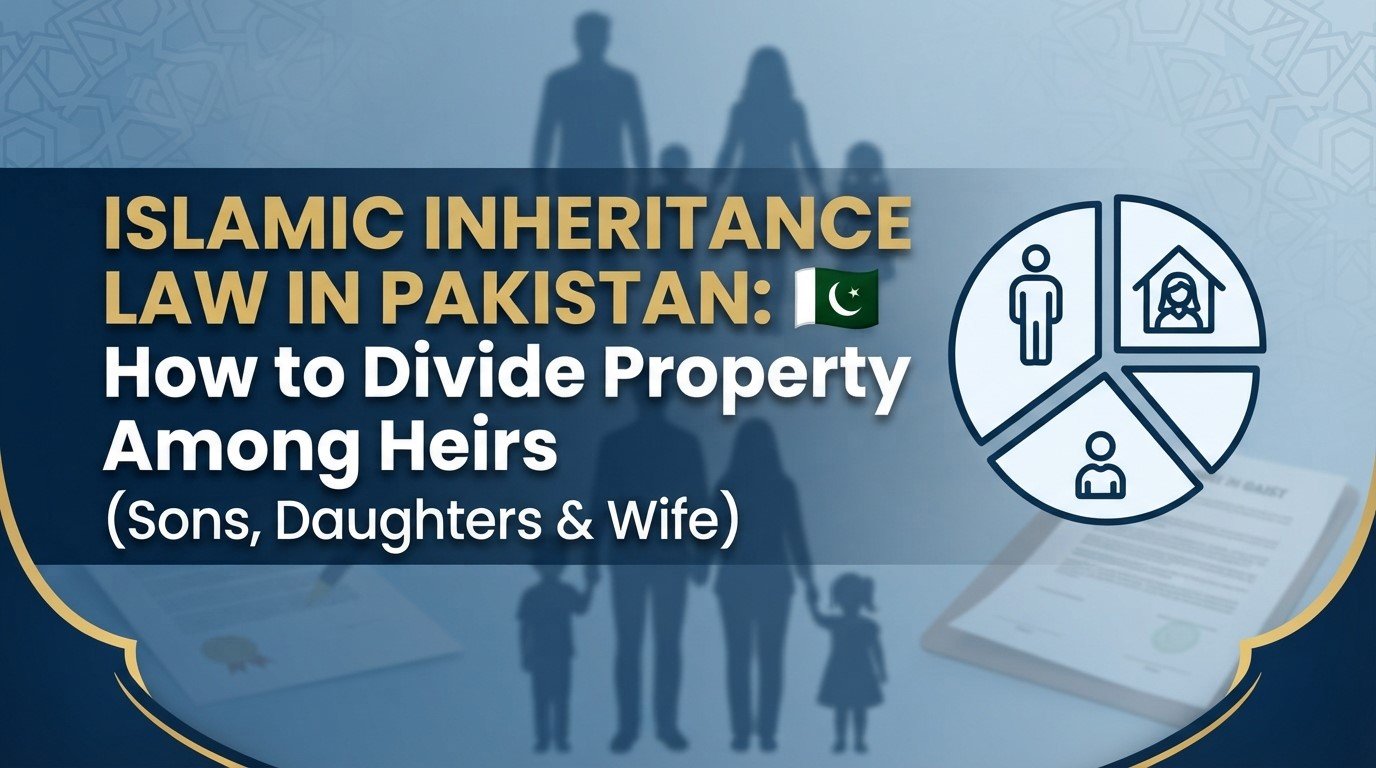
- Executive Summary
- Understanding Islamic Inheritance Law in Pakistan
- Fixed Shares Under Islamic Inheritance Law
- Step-by-Step Property Division Process
- Common Inheritance Disputes and Legal Solutions
- Special Considerations for Overseas Pakistanis
- Frequently Asked Questions About Islamic Inheritance
- How ASR Law Associates Handles Inheritance Cases
- Conclusion: Secure Your Family’s Legacy Through Proper Legal Channels
- Contact ASR Law Associates
- References
Executive Summary
Inheritance disputes are among the most common and emotionally charged legal matters in Pakistan. Understanding Islamic inheritance law in Pakistan is essential for ensuring fair distribution of property among heirs according to Sharia principles and statutory law. This comprehensive guide explains how to divide property among sons, daughters, wives, and other legal heirs under the Muslim Family Laws Ordinance 1961, Succession Act 1925, and established Islamic jurisprudence. Whether you are dealing with ancestral property, self-acquired assets, or agricultural land, this article provides accurate shares, legal procedures, and practical steps to obtain a succession certificate or letter of administration in Faisalabad and across Pakistan.
Understanding Islamic Inheritance Law in Pakistan
Legal Framework Governing Inheritance
Pakistan’s inheritance system operates under a dual framework combining Islamic principles with statutory legislation:
- Muslim Personal Law (Shariat) Application Act 1962: Mandates that inheritance for Muslims be governed by Islamic law .
- Muslim Family Laws Ordinance (MFLO) 1961: Regulates family matters including succession rights .
- Succession Act 1925: Provides procedural mechanisms for obtaining succession certificates and letters of administration .
- Provincial Land Revenue Acts: Govern inheritance of agricultural land specifically .
Key Principles of Islamic Inheritance
Islamic inheritance law (Mirath) follows fixed Quranic shares (Fara’id) that cannot be altered by will beyond one-third of the estate:
- Fixed Shares (Dhawu al-Furud): Specific heirs receive predetermined portions (e.g., wife receives 1/8 if children exist).
- Residuaries (Asabah): Male agnatic relatives inherit remaining estate after fixed shares.
- Exclusion Rules: Certain heirs exclude others from inheritance (e.g., son excludes grandson).
- No Disinheritance: Testators cannot disinherit legal heirs except through valid wasiyyah (will) limited to 1/3 of estate .
Fixed Shares Under Islamic Inheritance Law
Primary Heirs and Their Quranic Shares
| Heir | Share When Children Exist | Share When No Children Exist | Conditions |
|---|---|---|---|
| Wife | 1/8 | 1/4 | Reduced to 1/8 if deceased has children or grandchildren |
| Husband | 1/4 | 1/2 | Reduced to 1/4 if wife has children |
| Daughter | 1/2 (single), 2/3 (multiple) | N/A | Becomes residuary if son exists |
| Son | Residuary | Residuary | Receives double daughter’s share as residuary |
| Father | 1/6 + Residue | 1/6 | Gets fixed share plus residue if no male descendants |
| Mother | 1/6 | 1/3 | Reduced to 1/6 if deceased has children or siblings |
Important Note: These shares apply to Sunni Hanafi jurisprudence, which governs majority of Pakistani Muslims. Shia Jafari jurisprudence has different calculation methods .
Detailed Breakdown by Heir Category
1. Wife’s Share in Husband’s Property
Under Islamic inheritance law in Pakistan, a widow’s share depends on whether the deceased husband left descendants:
- With Children/Grandchildren: Wife receives 1/8 of net estate after funeral expenses, debts, and legacies.
- Without Children/Grandchildren: Wife receives 1/4 of net estate.
- Multiple Wives: Share is divided equally among all surviving wives .
Legal Reference: Section 4 of Muslim Family Laws Ordinance 1961 confirms widow’s inheritance rights regardless of polygamous marriages .
2. Daughter’s Inheritance Rights
Daughters have protected but variable shares:
- Single Daughter (No Son): Receives 1/2 of estate as fixed heir.
- Multiple Daughters (No Son): Collectively receive 2/3 of estate, divided equally.
- Daughter With Son: Becomes residuary; receives half of brother’s share (ta’sib).
- Orphaned Granddaughter: May inherit if father predeceased grandfather, subject to provincial amendments .
Critical Update: Some provinces have enacted legislation granting orphaned grandchildren inheritance rights, though implementation varies .
3. Son’s Share and Residuary Status
Sons do not have fixed Quranic shares but inherit as primary residuaries:
- Receive double the share of each daughter when inheriting jointly.
- Absorb entire residue after fixed-share heirs are satisfied.
- Exclude more distant male relatives (grandsons, brothers) from residuary status .
4. Parents’ Entitlements
- Father: Receives 1/6 fixed share if deceased has descendants; additionally inherits residue if no male descendants exist.
- Mother: Receives 1/6 if deceased has descendants or multiple siblings; receives 1/3 if no descendants and only one sibling or none .
Step-by-Step Property Division Process
Step 1: Determine Net Estate Value
Before distribution, deduct in this order:
- Funeral and burial expenses
- Outstanding debts (including unpaid dower/mahr)
- Valid legacies/wills (maximum 1/3 of remainder)
- Remaining amount constitutes distributable estate
Step 2: Identify All Legal Heirs
Compile complete list of heirs including:
- Spouse(s)
- Children (biological and legally adopted)
- Parents
- Predeceased children’s descendants (where applicable)
- Siblings (if no descendants or parents survive)
Documentation Required: CNIC copies, family registration certificates (FRC), marriage certificates, death certificates .
Step 3: Calculate Shares Using Fara’id Method
Apply Islamic arithmetic (Hisab al-Fara’id) to determine exact fractions:
- Assign fixed shares to eligible heirs.
- Find least common denominator (LCD) for all fractions.
- Allocate portions proportionally.
- Distribute residue to residuaries.
Example Calculation: Deceased leaves wife, 2 sons, 1 daughter, and mother. Estate value: Rs 12 million.
- Wife: 1/8 = Rs 1.5 million
- Mother: 1/6 = Rs 2 million
- Remaining: Rs 8.5 million
- Sons + Daughter ratio: 2:2:1 (each son gets 2 parts, daughter gets 1 part)
- Total parts: 5
- Each part: Rs 1.7 million
- Each son: Rs 3.4 million
- Daughter: Rs 1.7 million
Step 4: Obtain Legal Documentation
Choose appropriate legal instrument based on asset type:
| Document Type | Applicable Assets | Issuing Authority | Timeline |
|---|---|---|---|
| Succession Certificate | Movable assets (bank accounts, stocks, vehicles) | District Court / Civil Judge | 2-4 months |
| Letter of Administration | Immovable property without will | District Court | 3-6 months |
| Probate | Immovable property with valid will | District Court | 4-8 months |
| Mutation Entry | Agricultural/revenue land | Patwari / Revenue Officer | 1-3 months |
Legal Requirement: Courts require publication of notice in newspaper and 30-day objection period before issuing certificates .
Step 5: Transfer Ownership
After obtaining court orders:
- Register immovable property at Sub-Registrar Office
- Update bank records with succession certificate
- Mutate agricultural land in revenue records
- Pay applicable stamp duty and transfer taxes
Common Inheritance Disputes and Legal Solutions
1. Denial of Female Heirs’ Rights
Despite clear Islamic mandates, daughters and widows frequently face exclusion.
Legal Remedies:
- File suit for declaration of inheritance rights under Section 42, Specific Relief Act 1877
- Seek partition decree under Partition Act 1893
- Report to Provincial Commission on Status of Women
2. Disputed Paternity or Marriage Validity
Challenges arise regarding legitimacy of heirs or validity of marriages.
Evidence Standards:
- Nikkahnama registered under MFLO 1961 is prima facie evidence
- DNA testing admissible per Supreme Court ruling in Mst. Yasmin v. State (2023)
- Oral testimony requires two male witnesses or four female witnesses
3. Unregistered Wills Exceeding 1/3 Limit
Testators sometimes attempt to bequeath more than permissible third.
Judicial Position:
- Bequests exceeding 1/3 require consent of all legal heirs
- Without consent, excess portion reverts to residuary heirs
- Courts strictly enforce this limitation
4. Agricultural Land vs. Urban Property Distinction
Agricultural land inheritance may follow customary practices conflicting with Sharia.
Current Law:
- Shariat Application Act 1962 overrides custom for Muslim estates
- However, provincial land revenue laws create procedural complexities
- Consult specialist lawyer familiar with both systems
Special Considerations for Overseas Pakistanis
Overseas Pakistanis face unique challenges managing inheritance remotely:
Power of Attorney Requirements
- Must be attested by Pakistani Embassy/Consulate abroad
- Requires verification from Ministry of Foreign Affairs upon arrival
- Limited POA recommended over general POA to prevent misuse
Remote Litigation Options
- Engage licensed attorney in relevant district
- Video conferencing permitted for certain hearings post-2024 amendments
- Digital filing available in Islamabad, Lahore, Karachi courts
Tax Implications
- No inheritance tax currently levied in Pakistan
- Capital gains tax applies if inherited property sold within specified periods
- Foreign income reporting obligations in country of residence may apply
Frequently Asked Questions About Islamic Inheritance
Q1: Can a Muslim make a will for more than one-third of their property?
Answer: No. Under Islamic law applicable in Pakistan, testamentary disposition is limited to one-third of net estate. Any bequest exceeding this limit requires unanimous consent of all legal heirs to be valid. Without such consent, the excess reverts to residuary heirs .
Q2: Do adopted children inherit under Islamic law in Pakistan?
Answer: No. Traditional Islamic law does not recognize adoption as creating inheritance rights. Adopted children may receive up to one-third through valid will, but have no automatic entitlement as legal heirs. Guardianship (kafalah) differs fundamentally from adoption .
Q3: What happens if an heir dies before receiving their share?
Answer: The deceased heir’s share passes to their own legal heirs through separate inheritance proceeding. This creates cascading succession requiring individual calculations for each generation. Consolidated proceedings may be possible with court permission .
Q4: Is there time limit for claiming inheritance in Pakistan?
Answer: While inheritance rights themselves do not expire, procedural limitations apply. Suits for possession must generally be filed within 12 years under Limitation Act 1908. Succession certificate applications have no strict deadline but delays complicate evidence gathering .
Q5: How are non-Muslim heirs treated in mixed-faith families?
Answer: Non-Muslim spouses and relatives cannot inherit from Muslim decedents under Islamic law. They may receive bequests through valid will (within 1/3 limit). Interfaith inheritance remains complex area requiring specialized counsel .
How ASR Law Associates Handles Inheritance Cases
ASR Law Associates provides comprehensive inheritance legal services across Pakistan:
Our Expertise Includes
- Share Calculation: Precise Fara’id computations compliant with Hanafi/Jafari jurisprudence
- Court Representation: Succession certificate and letter of administration petitions
- Dispute Resolution: Mediation and litigation for contested inheritances
- Document Preparation: Mutation applications, transfer deeds, affidavits
- Overseas Client Support: Remote consultation and POA facilitation
Why Families Trust ASR
- 20+ years combined experience in family and property law
- Deep knowledge of both Islamic jurisprudence and statutory requirements
- Transparent fee structure with no hidden charges
- Confidential handling of sensitive family matters
- Online consultations available nationwide
Conclusion: Secure Your Family’s Legacy Through Proper Legal Channels
Islamic inheritance law in Pakistan balances divine mandate with legal procedure. While Quranic shares provide clear guidance, practical implementation requires navigating court processes, documentation requirements, and potential family disputes. Misunderstanding even minor details can lead to prolonged litigation and fractured relationships.
Whether dividing property among sons, daughters, wives, or extended family members, professional legal guidance ensures compliance with both religious obligations and statutory law. Early consultation prevents costly errors and preserves family harmony during difficult transitions.
Take Action Today: Do not rely on informal agreements or outdated advice. Contact ASR Law Associates for accurate share calculations, document preparation, and court representation tailored to your specific situation.
Contact ASR Law Associates
Phone: +92 300 6645931
Location: Faisalabad, Pakistan (Serving Nationwide)
Services: Inheritance Law, Property Division, Succession Certificates, Family Disputes
Consultation: Online and In-Person Available
Disclaimer: This article provides general information on Islamic inheritance law in Pakistan and does not constitute legal advice. Individual circumstances vary significantly. Always consult qualified legal counsel for case-specific guidance. Laws and judicial interpretations are subject to change. Verify current regulations with relevant authorities before taking action.
References
- Government of Pakistan. Muslim Personal Law (Shariat) Application Act, 1962. National Assembly of Pakistan.
- Government of Pakistan. Muslim Family Laws Ordinance, 1961. Ministry of Law and Justice.
- Government of India (applicable in Pakistan). Succession Act, 1925. Federal Legislative List.
- Government of Punjab. Punjab Land Revenue Act, 1967. Board of Revenue, Punjab.
- Imran Ahsan Khan Nyazee. Islamic Jurisprudence (Usul al-Fiqh). International Institute of Islamic Thought, 2003.
- Syed Ameer Ali. Principles of Muhammadan Law. Lahore: All Pakistan Legal Decisions, 2018.
- Tanzil-ur-Rahman. A Code of Muslim Personal Law. Karachi: Hamdard Academy, 1990.
- Supreme Court of Pakistan. Ghulam Ali v. Ghulam Sarwar, PLD 1990 SC 1.
- National Assembly of Pakistan. Punjab Protection of Women Against Violence Act, 2016. Provincial Assembly of Punjab.
- Registrar General, Punjab. Registration Manual and Guidelines. Government of Punjab, 2024.
- Commission on the Status of Women, Punjab. Annual Report on Women’s Inheritance Rights. CSWP, 2025.
- Supreme Court of Pakistan. Mst. Yasmin v. State, 2023 SCMR 1245.
- Ministry of Foreign Affairs. Guidelines for Attestation of Documents Abroad. Government of Pakistan, 2025.
- Lahore High Court. Practice Direction on Virtual Hearings, Notification No. 45/2024.
- Federal Board of Revenue. Capital Gains Tax Guide 2026. FBR Publications.
- Islamic Fiqh Academy. Resolution on Adoption and Kafalah. OIC, 2019.
- Limitation Act, 1908. Schedule I, Article 144.
- Council of Islamic Ideology. Report on Interfaith Family Matters. CII, 2022.