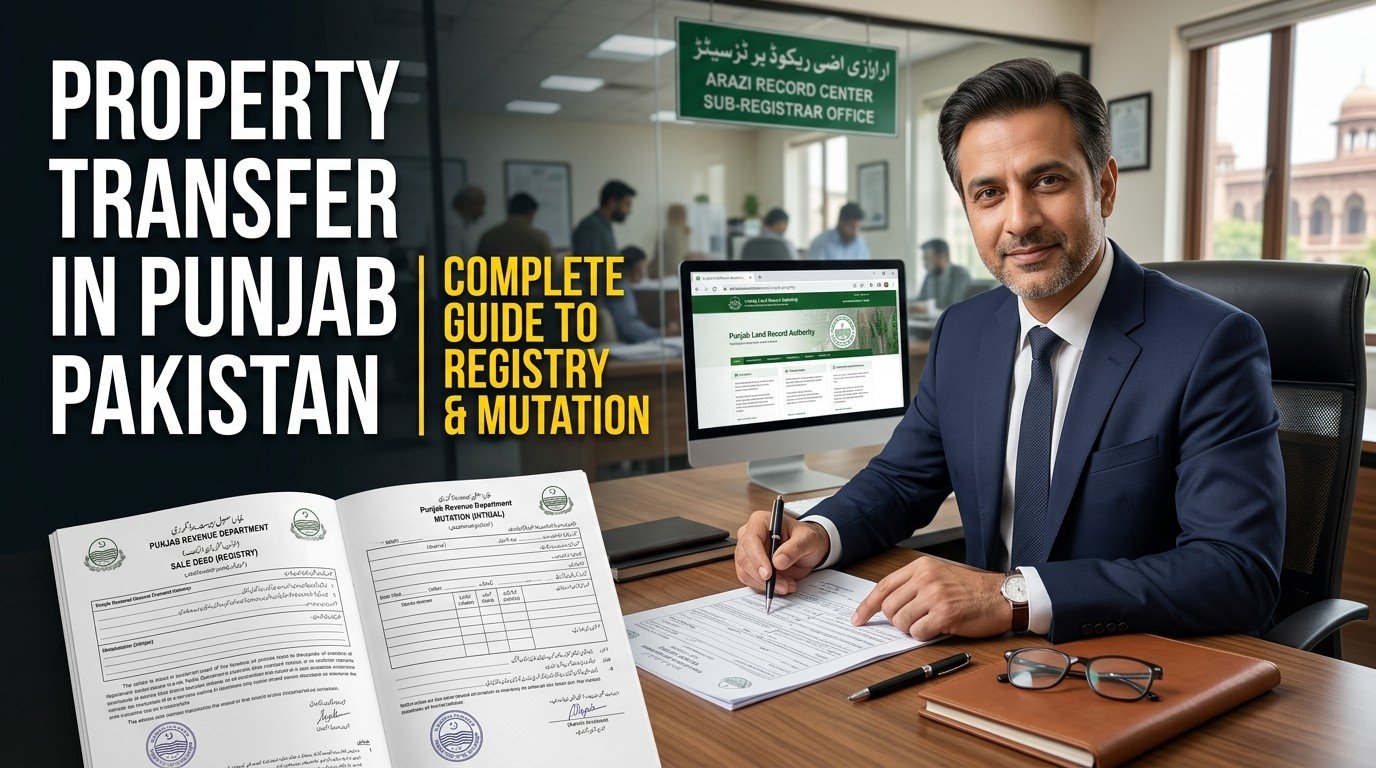
Transferring property ownership in Punjab, Pakistan, requires two essential steps: registration of the transfer deed (sale deed, gift deed, or other instrument) before the Sub-Registrar and mutation (intiqal) to update the official land revenue records through the Punjab Land Records Authority (PLRA). Skipping mutation leaves the buyer without full administrative ownership even if they hold a registered deed.
This comprehensive guide covers everything you need for a smooth, legally secure property transfer in Punjab whether by sale, gift (hiba), or inheritance. It is designed for buyers, sellers, and overseas Pakistanis dealing with land, houses, or plots in cities like Lahore, Faisalabad, Rawalpindi, Multan, and rural areas.
- Why Proper Property Transfer Matters in Punjab
- Legal Framework Governing Property Transfer in Punjab
- Modes of Property Transfer in Punjab
- Step-by-Step Process for Property Transfer by Sale in Punjab
- Documents Required for Property Transfer in Punjab
- Mutation (Intiqal) Process in Detail – PLRA Arazi Record Centers
- Gift Deed (Hiba) and Inheritance Transfers
- Common Mistakes to Avoid
- Tips for Overseas Pakistanis (NRIs / Overseas)
- Frequently Asked Questions (FAQs)
- Why Choose Professional Legal Help?
Why Proper Property Transfer Matters in Punjab
A correctly completed transfer protects against fraud, enables future sales or mortgages, allows utility transfers and tax payments in the new owner’s name, and creates a clear chain of title. Punjab has strengthened digital processes through PLRA’s Arazi Record Centers (ARCs), biometric verification, and e-registration to reduce disputes and oral transfers.
ASR Law Associates, a trusted property law firm based in Faisalabad serving clients across Pakistan, regularly assists with title verification, deed drafting, registration, mutation follow-up, and dispute resolution. Contact our property lawyers for personalized guidance.
Legal Framework Governing Property Transfer in Punjab
Key laws include:
- Transfer of Property Act, 1882
- Registration Act, 1908
- Stamp Act, 1899 (as amended in Punjab)
- Punjab Land Revenue Act and PLRA rules
- Income Tax Ordinance provisions on advance tax (Sections 236C and 236K)
Registration of deeds involving immovable property is compulsory under Section 17 of the Registration Act. Mutation updates the Record of Rights (Fard/Jamabandi).
Modes of Property Transfer in Punjab
- Sale (Bai / Sale Deed) — Most common. Requires consideration (payment).
- Gift (Hiba) — Voluntary transfer without consideration; often used within family.
- Inheritance (Wirasat / Intiqal by Succession) — After the owner’s death, based on Islamic inheritance rules or Succession Act.
- Exchange, Relinquishment, or Partition — Between co-owners or for division of joint property.
- Court Order or Power of Attorney transfers (with strict verification).
Housing society plots (DHA, Bahria, etc.) usually require additional society transfer before or alongside registry and mutation.
Step-by-Step Process for Property Transfer by Sale in Punjab
1. Due Diligence and Title Verification
Obtain a fresh Fard-e-Malkiat (or Fard Baraye Bay for sale) from PLRA (online at punjab-zameen.gov.pk or nearest Arazi Record Center). Verify:
- Seller is the recorded owner
- No encumbrances, court stays, or competing claims
- Complete chain of previous mutations and registries
- Clearance of property tax and utility dues
- Society NOC / Non-Dues Certificate if applicable
Cross-check CNIC details and physical boundaries.
2. Agreement to Sell (Optional but Recommended)
Draft a written agreement stating price, payment schedule, possession terms, and timelines. Prefer bank channels for payments above certain thresholds.
3. Prepare the Sale Deed (Bai Nama)
A lawyer drafts the deed on e-stamp paper with full party details (names, CNICs), exact property description (khewat, khasra, area, location), consideration amount, and possession clause. Two adult witnesses are required.
4. Pay Applicable Taxes and Fees
Generate challans through the e-stamping / e-registration system and pay at Bank of Punjab. Charges typically include:
- Stamp duty (provincial)
- Registration fee
- PLRA service / mutation-related fees
- Local government / TMA / district council fee (where applicable)
- Federal advance tax under Section 236K (buyer) and 236C (seller)
Important: Rates change. Always generate a live challan on the official portal or confirm with the Sub-Registrar for the exact district and valuation (higher of declared value, DC rate, or FBR valuation table). Recent sources indicate stamp duty around 1–2% depending on urban/rural status and amendments, with FBR filer rates under 236K at approximately 1.25% and 236C at 2.75% (non-filers pay substantially higher). PLRA service charges for e-registration and mutation have also been revised.
5. Register the Deed at the Sub-Registrar Office
Both parties (or authorized attorneys with valid Power of Attorney) and two witnesses appear in person. Biometric verification (NADRA-linked) is standard. The Sub-Registrar records statements, and the deed is registered (Bahi number and document number issued). Registration must generally occur within four months of execution.
Many districts now use PLRA’s e-registration portal (eregistration.punjab-zameen.gov.pk).
6. Apply for Mutation (Intiqal) at PLRA
This is the critical second step. Visit the relevant Arazi Record Center with the registered deed, CNICs, and property details. Process typically includes:
- Token and biometric verification
- Submission of documents
- Fee payment
- Verification and attestation by the Revenue Officer
- Update of land records
In some computerized mouzas, mutation may be linked automatically with e-registry; otherwise, apply promptly. A certified copy of the updated mutation/Fard can then be obtained.
7. Take Possession and Update Records
Document handover of possession. Update society records, utilities, and property tax if needed.
Documents Required for Property Transfer in Punjab
Common for Sale:
- Original CNICs of buyer, seller, and witnesses (plus copies)
- Fresh Fard / Fard Baraye Bay
- Previous title deed / registry / mutation documents
- Draft sale deed on proper stamp paper / e-stamp
- Photographs of parties
- Payment challans (stamp duty, taxes, fees)
- NOC / Non-Dues Certificate (society, bank if mortgaged, or local authority)
- Proof of payment of consideration (where required)
For Inheritance Mutation:
- Death certificate
- NADRA Family Registration Certificate (FRC)
- Affidavit by applicant heir
- CNIC copies of all legal heirs
- Property details / existing Fard
For Gift (Hiba):
- Similar to sale plus clear statement of gift and delivery of possession.
Always carry originals for verification.
Mutation (Intiqal) Process in Detail – PLRA Arazi Record Centers
Mutation records the change of ownership in the jamabandi/record of rights. Without it, the new owner faces difficulties selling, mortgaging, or dealing with authorities.
Steps at ARC:
- Biometric registration and token
- Document submission and data entry
- Fee challan and payment
- Verification (may include field check or notice period in some cases)
- Attestation by authorized officer
- Updated record available
Bai-zubani (oral) mutations are increasingly restricted in favor of documented transfers.
Gift Deed (Hiba) and Inheritance Transfers
Gift: Draft a registered gift deed (stamp duty typically lower or similar to sale depending on urban/rural and relationship), execute before witnesses, register, then mutate. Delivery of possession is essential under Islamic law principles.
Inheritance: Any legal heir can apply for mutation at the ARC with death certificate, FRC, and supporting documents. Shares follow Islamic inheritance (Fara’id) rules for Muslims. For detailed guidance on shares of sons, daughters, and wife, see our related article on Islamic Inheritance Law in Pakistan.
Common Mistakes to Avoid
- Relying only on a sale agreement without registration and mutation
- Accepting outdated Fard or incomplete title chain
- Paying cash without bank trail for large amounts
- Delaying mutation after registry
- Ignoring society transfer formalities for plotted schemes
- Using incomplete or poorly drafted deeds
- Failing to clear outstanding dues or obtain NOCs
Fraud risks remain high — always involve independent verification.
Tips for Overseas Pakistanis (NRIs / Overseas)
Use a carefully drafted Power of Attorney (preferably registered and specific). Engage a reliable local lawyer for physical presence requirements, biometric steps, and follow-up. Digital PLRA services help, but personal or authorized appearance is still needed for key stages.
Frequently Asked Questions (FAQs)
How long does property transfer take in Punjab?
Registry can often be completed in one day once documents and payments are ready. Mutation typically takes a few days to a few weeks depending on verification and workload.
Is mutation mandatory after registry?
Yes for full legal and practical ownership in revenue records.
Where can I apply?
Sub-Registrar for registration; nearest Arazi Record Center or online PLRA portal for mutation and Fard. Official site: punjab-zameen.gov.pk.
What if there is a dispute or illegal possession (qabza)?
Seek immediate legal remedies. See our guide on removing illegal possession in Punjab.
Do rates change?
Yes. Always verify current stamp duty, PLRA fees, and FBR advance tax rates via official challans or the Sub-Registrar before payment.
Why Choose Professional Legal Help?
Property transfer involves significant money and long-term rights. Errors in documentation, valuation, or procedure can lead to costly litigation. ASR Law Associates specializes in property law across Punjab — title searches, deed drafting, registration support, mutation assistance, inheritance matters, and dispute resolution. We offer both in-person and secure online consultations.
Protect your investment. Contact ASR Law Associates today for expert assistance with property transfer in Punjab, Pakistan.
Visit our homepage | Contact Us | Call: +92 300 6645931
This guide is for informational purposes and reflects procedures current as of late 2026. Laws, fees, and processes can change. Always consult a qualified lawyer and verify with official PLRA / Sub-Registrar / FBR sources for your specific case.