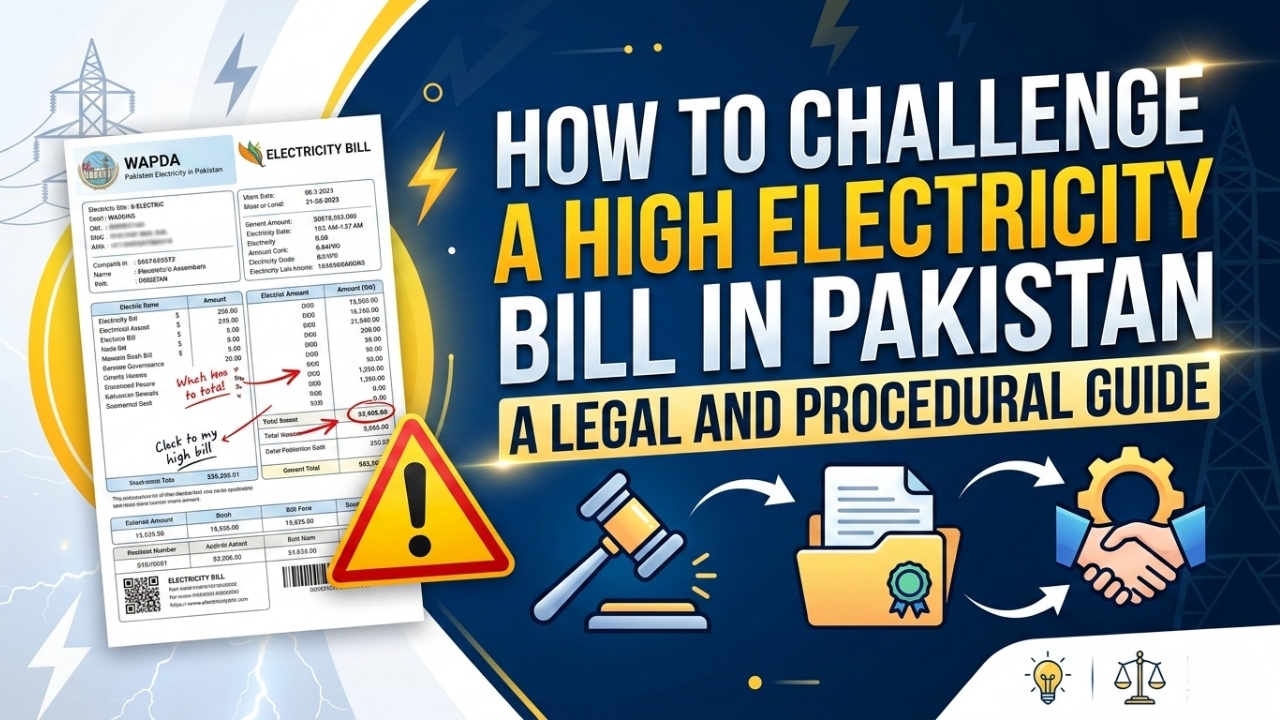
In 2026, electricity tariffs in Pakistan have reached an all-time high, making every unit on your meter count. At ASR Law Associates, we receive hundreds of queries regarding “Overbilling,” “Bogus Readings,” and “Detection Bills.” Most consumers feel helpless against the power of Distribution Companies (DISCOs) like LESCO, K-Electric, FESCO, or MEPCO. However, the law provides a robust mechanism to challenge these discrepancies.
Under the NEPRA Consumer Service Manual (CSM) and the Electricity Act 1910, consumers have the right to accurate billing. If your bill does not reflect your actual consumption, you are not legally obligated to pay the disputed amount until the matter is investigated. This 1,500 word guide explains the exact steps to rectify your bill.
1. Initial Analysis: Is the Bill Actually “Wrong”?
Before heading to the WAPDA or DISCO office, you must identify the technical reason for the high bill. Check your bill for these four common culprits:
- Bogus Reading: Compare the “Present Reading” on your bill with the actual numbers on your physical meter. If the bill shows a higher number than the meter, it is a clear case of “Reading recorded in excess.”
- Slab Jump: Pakistan uses a “Slab System” where the price per unit increases significantly after 100, 200, or 300 units. A small error in reading can push you into a much more expensive category.
- Detection Bill: This is a “fine” added to your bill if the DISCO suspects meter tampering or “Kunda” (illegal hooking). Legally, a detection bill cannot be issued without a proper site inspection report and notice.
- Fuel Price Adjustment (FPA): This is a retrospective charge approved by NEPRA. While frustrating, it is usually a legal charge applied to all consumers and cannot be challenged individually unless the calculation is wrong.
2. Step 1: Filing the Formal Complaint (Sub-Division Level)
Your first legal step is to approach the Assistant Manager Operations (AMO) or the Sub-Divisional Officer (SDO) of your specific area.
- Draft a Formal Application: Address it to the SDO. State your Reference Number, the month of the disputed bill, and the specific error (e.g., “Mismatched meter reading”).
- Attach Evidence: Provide a clear photograph of your current meter reading and a copy of the disputed bill.
- Request a “Correction”: Ask for the bill to be revised under the Consumer Service Manual guidelines.
- Get a Dairy Number: This is the most important part. Ensure the office stamps your copy of the application with a “Diary Number” or “Reference Number.” This is your legal proof that you initiated the complaint.
3. Step 2: The Role of the Customer Complaint Management System (CCMS)
If the local office is non-responsive, you must use the digital route. In 2026, the Power Information Technology Company (PITC) monitors all complaints through the CCMS Portal.
- Portal URL: https://ccms.pitc.com.pk/
- Procedure: Enter your 14-digit Reference Number. Select “Billing Complaint” as the category. Upload your photo evidence.
- The “30-Day Rule”: Under the current regulations, the DISCO is legally bound to resolve a billing complaint within 30 days. If they fail to do so, the complaint is automatically escalated to the Ministry of Energy.
4. Step 3: Escalation to the Electric Inspector (Provincial Level)
If the DISCO rejects your complaint, your next legal forum is the Provincial Electric Inspector (PEI). The Electric Inspector is a quasi-judicial authority appointed by the provincial government to resolve disputes between consumers and power companies.
When to approach the Electric Inspector:
- When the DISCO refuses to correct a “Bogus Reading.”
- When you are charged a “Detection Bill” for alleged theft without proof.
- When your meter is “Slow” or “Fast” and needs a neutral laboratory test.
The Legal Procedure at the PEI Office:
You must file a petition under Section 26(6) of the Electricity Act 1910. The Inspector will summon both the consumer and the DISCO representative. If the Inspector finds in your favor, they will issue an “Award” ordering the DISCO to withdraw the illegal charges.
5. Step 4: Approaching the NEPRA Consumer Affairs Division (CAD)
The National Electric Power Regulatory Authority (NEPRA) is the ultimate regulator. If the DISCO is violating the Consumer Service Manual (CSM), NEPRA can intervene.
- Online Complaint: Use the “NEPRA Asaan Lodgement” system.
- Grounds for NEPRA Intervention: If the DISCO is not replacing a defective meter within two billing cycles or if they are charging “Average Units” for more than two months (which is prohibited under Clause 4.3 of the CSM).
6. Step 5: The Federal Ombudsman (Wafaqi Mohtasib)
The Wafaqi Mohtasib has a dedicated department for “Maladministration” in utility companies. This is a free service that does not require a lawyer.
- Requirement: You must show that you already complained to the DISCO and they did not provide relief.
- Timeline: The Ombudsman is legally required to decide the case within 60 days.
- Enforcement: The decisions of the Wafaqi Mohtasib are binding on WAPDA and all DISCOs. Failure to comply can result in contempt proceedings against the XEN or SE of the company.
7. Understanding “Detection Bills” and Your Rights
A detection bill is often used as a tool for harassment. If the police or DISCO staff raid your premises and claim you are stealing electricity, remember:
- They must provide a Detection Bill Notice.
- They must show you the “Evidence of Tampering” (e.g., broken seals or a hole in the meter).
- They must calculate the detection units based on your “Previous Consumption History” or “Connected Load,” whichever is lower, for a maximum of six months.
Lawyer’s Tip: If you receive a detection bill, do not pay it immediately. Filing a case in the Civil Court or with the Electric Inspector can stay the disconnection of your electricity while the case is pending.
8. Prosumer Rights: Net Metering Disputes (2026 Update)
As many Pakistanis have switched to solar power, “Net Metering” disputes have become common. The NEPRA (Prosumer) Regulations 2026 protect solar users.
- Export vs. Import Credits: If the DISCO is not properly crediting the units you exported to the grid, you can challenge this as “Accounting Maladministration.”
- Bi-Directional Meter Faults: If your green meter is recording “Import” but not “Export,” the DISCO must replace it within 7 working days.
9. Essential Documents Checklist
To challenge a bill successfully, keep these documents ready:
- Copies of the last 6 months’ bills (to show your “Typical Consumption Pattern”).
- CNIC of the owner (or the person in whose name the connection is registered).
- Photographs of the meter reading with a date/time stamp.
- Any previous correspondence or “Diary Numbers” from the DISCO.
- A “Test Report” if the dispute is about a defective meter.
10. Conclusion: Don’t Let Overbilling Stand
High electricity bills are often the result of administrative negligence or technical errors. By following the legal hierarchy: starting from the SDO, moving to the CCMS, and eventually reaching the Electric Inspector or Ombudsman: you can protect your rights as a consumer.
At ASR Law Associates, we have successfully helped residential and industrial clients recover millions in overcharged units. The law is on the side of the consumer, provided you follow the correct procedural steps.
Need Legal Assistance for a Utility Dispute?
If you are facing an unfair detection bill or chronic overbilling and the local office is not cooperating, our legal team can represent you before the Electric Inspector or the Wafaqi Mohtasib.
Contact Us: To schedule a consultation or request assistance with a utility complaint, please visit our contact page: https://asrlawassociates.com/contact/
Disclaimer: This article provides general informational guidance. Electricity laws and tariffs are subject to frequent changes by the Government of Pakistan. For specific legal disputes, always consult with a qualified legal professional.