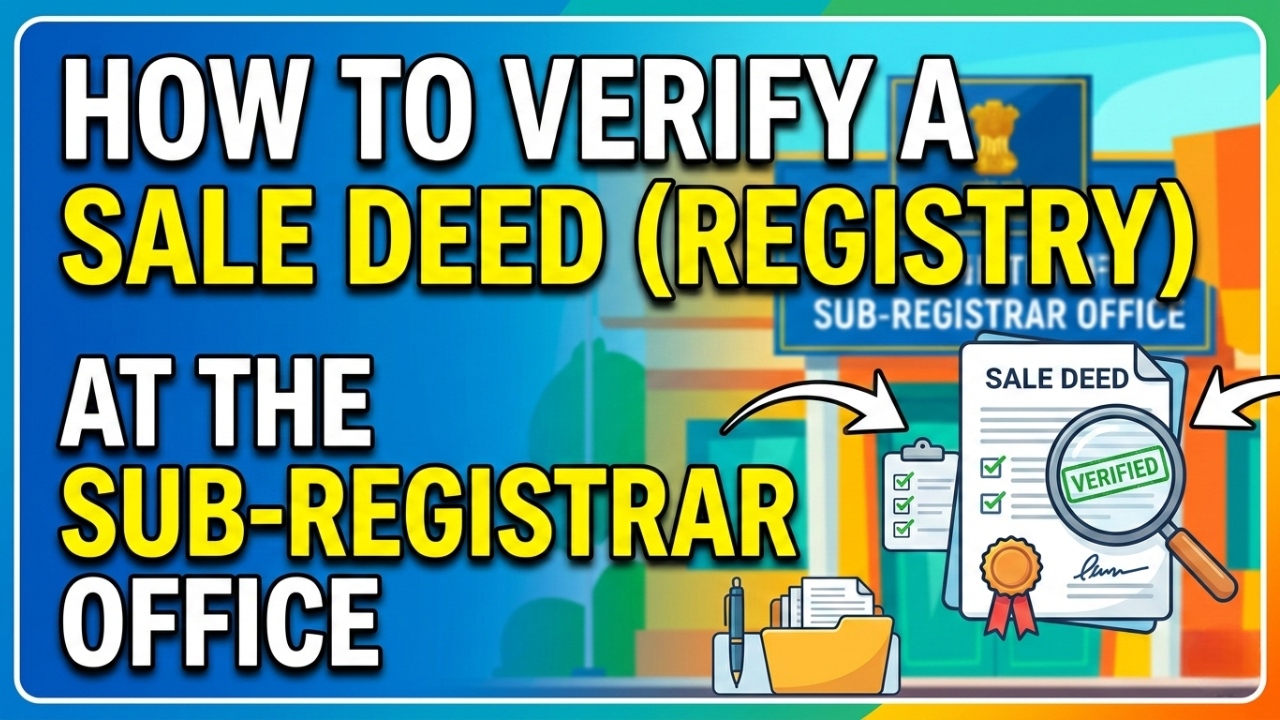
A Sale Deed, locally known as the “Registry” or “Bay-Nama,” is the primary legal instrument that transfers ownership of immovable property from a seller to a buyer under the Registration Act 1908. While the Fard-e-Malkiat (Revenue Record) shows who currently owns the land, the Sale Deed is the evidence of the transaction itself.
In 2026, the verification process has evolved. While Punjab has shifted toward the e-Registration system, other areas still rely on manual ledgers. Verifying a deed requires a “Title Search,” which involves tracing the history of the property to ensure the seller’s title is “clear, marketable, and free from encumbrances.”
1. Why Verify at the Sub-Registrar Office?
You might wonder: “If I have a Fard from the Punjab Land Records Authority (PLRA), why do I need to visit the Sub-Registrar?”
The answer lies in the legal hierarchy. The Sub-Registrar’s office holds the “Book 1” (Register of Deeds).
- The Revenue Record (Fard/Mutation): This is a record for taxation and administrative purposes. It can sometimes be updated based on fraudulent documents.
- The Registry (Sale Deed): This is the fundamental title. If a Registry is fake, the subsequent Mutation (Intiqal) is legally void.
Verifying at the Sub-Registrar’s office ensures that the deed was actually executed, signed by a real officer, and stamped with the correct government duties.
2. Step 1: Identifying the Jurisdiction
Before you begin, you must identify which office holds the record. Properties are registered based on their Tehsil and Mauza (Village/Area).
- Lahore: There are multiple Sub-Registrar offices (e.g., Model Town, Cantt, Shalimar).
- Islamabad: Registry is handled by the Registrar of Islamabad (ICT Administration).
- Karachi: Records are maintained by the Sub-Registrar of Assurances in respective districts (East, West, South, Central).
3. Step 2: The “Bahi” (Manual Ledger) Search
In many parts of Pakistan, historical records (pre-2015) are still kept in large manual ledgers called Bahi Number 1.
- Request a Search (Nikal): You must file a formal application for a “Search of Records” for a specific year.
- Provide the Parcha (Receipt): Every registered deed has a “Wasiqa Number” (Document Number), a “Jild Number” (Volume), and a “Safha Number” (Page). Without these, a manual search is nearly impossible.
- The Record Room (Muhafiz Khana): The Record Clerk (Moharrir) will pull the volume. You (or your lawyer) should verify that the thumb impressions, photographs, and signatures on the official copy match the one held by the seller.
4. Step 4: Digital Verification (The 2026 e-Registration Portal)
For any property registered in Punjab after 2023, the verification process has moved online via the National Generic Document Registration System (NGDRS) or the e-Registration Portal.
How to Verify Online:
- Visit the Portal: Go to the Punjab e-Registration Portal.
- Search by E-Stamp Number: Every modern deed is printed on a secure e-stamp paper. Enter the 16-digit e-stamp number on the e-Stamping Verification site to see if the duty was actually paid.
- QR Code Scanning: 2026 Sale Deeds come with a unique QR code. Scanning this via the official app should pull up the digital copy of the deed directly from the Government of Punjab’s servers.
5. Step 5: Comparing the “Registry” with the “Mutation”
A common scam involves a seller showing a valid Registry but concealing the fact that they have already sold the property to someone else, and a newer Mutation (Intiqal) has been recorded.
| Feature | Sale Deed (Registry) | Mutation (Intiqal) |
| Legal Status | Primary Title Document | Administrative Record Entry |
| Issued By | Sub-Registrar | Tehsildar/Patwari/PLRA |
| Verification Place | Registrar Office | Arazi Record Center (ARC) |
| Risk | Can be “Unmutated” | Can be based on a fake deed |
Lawyer’s Advice: Always ensure the Registry has been “attested” into the revenue record. A “Lapsed Registry” (where a buyer forgot to do the mutation) is a major legal vulnerability.
6. Detecting a “Fake Registry”
When inspecting a physical copy of a Sale Deed, look for these “Red Flags”:
- Missing Seals: Every page must have the round seal of the Sub-Registrar.
- Back-Dated Stamp Papers: Check the date the stamp paper was issued. If the deed was executed in 2010 but the stamp paper was issued in 2012, it is a forgery.
- Overwriting: Any changes in the plot number or area size must be signed by the Registrar. If not, the document is suspicious.
- Biometric Mismatch: In 2026, all registries require NADRA biometric verification. Ask for the “Biometric Verification Slip” that was issued at the time of registration.
7. The Role of the “Encumbrance Certificate”
In cities like Karachi, you can apply for a Non-Encumbrance Certificate (NEC) from the Sub-Registrar. This is an official document certifying that, according to the office records, the property has not been sold, mortgaged, or gifted to anyone else during a specific period (usually 15 to 30 years).
8. Property Search for Overseas Pakistanis
If you are an Overseas Pakistani, you do not need to fly to Pakistan to verify a deed.
- Grant a Limited Power of Attorney: You can authorize a law firm like ASR Law Associates to perform the search.
- Certified Copies: We can apply for a “Certified True Copy” (Sadaqat Nama) of the deed from the Sub-Registrar. This is a government-issued copy that carries the same legal weight as the original in court.
9. What to Do If the Registry is Missing or Disputed
If the Sub-Registrar’s office tells you that “the record is missing” or “the page is torn,” this is a critical warning.
- Civil Suit: You may need to file a “Suit for Declaration” in the Civil Court to establish your title.
- Reconstruction of Record: There is a legal process to “reconstruct” a burnt or lost record if you possess the original deed and can prove its authenticity through witnesses.
10. Documents You Need to Take for Verification
To perform a search at the Sub-Registrar office, bring:
- A photocopy of the Sale Deed you wish to verify.
- Your original CNIC.
- The “Khatooni” and “Khasra” numbers of the land.
- The prescribed “Search Fee” challan (usually paid at the Bank of Punjab or National Bank).
11. Conclusion: The Final Word on Title Safety
Verifying a Sale Deed at the Sub-Registrar’s office is the “Final Frontier” of property due diligence. While digital portals have made the process easier, the manual record remains the ultimate legal proof in the courts of Pakistan. Never rely solely on a photo of a document; always insist on a Certified Search Report.
At ASR Law Associates, our team of property lawyers performs daily audits at Sub-Registrar offices across Lahore, Islamabad, and Faisalabad. We ensure that the property you are buying has a “Chain of Title” that is unbroken and legally sound.
Request a Professional Title Search Report
Don’t risk your savings on a questionable “Registry.” Let our legal experts verify the authenticity of your property documents directly from the government archives.
ASR Law Associates
- Specialization: Land Revenue Law, Registry Verification, and Mutation Appeals.
- Contact Page: https://asrlawassociates.com/contact/
Disclaimer: This article is for educational purposes. Property laws in Pakistan, particularly tax rates and digital procedures, are subject to change by the provincial Boards of Revenue. Always consult a licensed advocate for your specific property transaction.